FGCU’s new summer residency program places participating faculty members with construction-related companies to observe current industry practices and gain updated skills by working directly with local firms.
While equipping faculty with real-world insights that enhance classroom teaching and learning, the program also helps build a more robust network between the university and construction profession partners.
The main objective of the initiative is to strengthen the connection between what is taught in the classroom and what is actually taking place in the construction industry, according to Long Nguyen, professor and department chair.
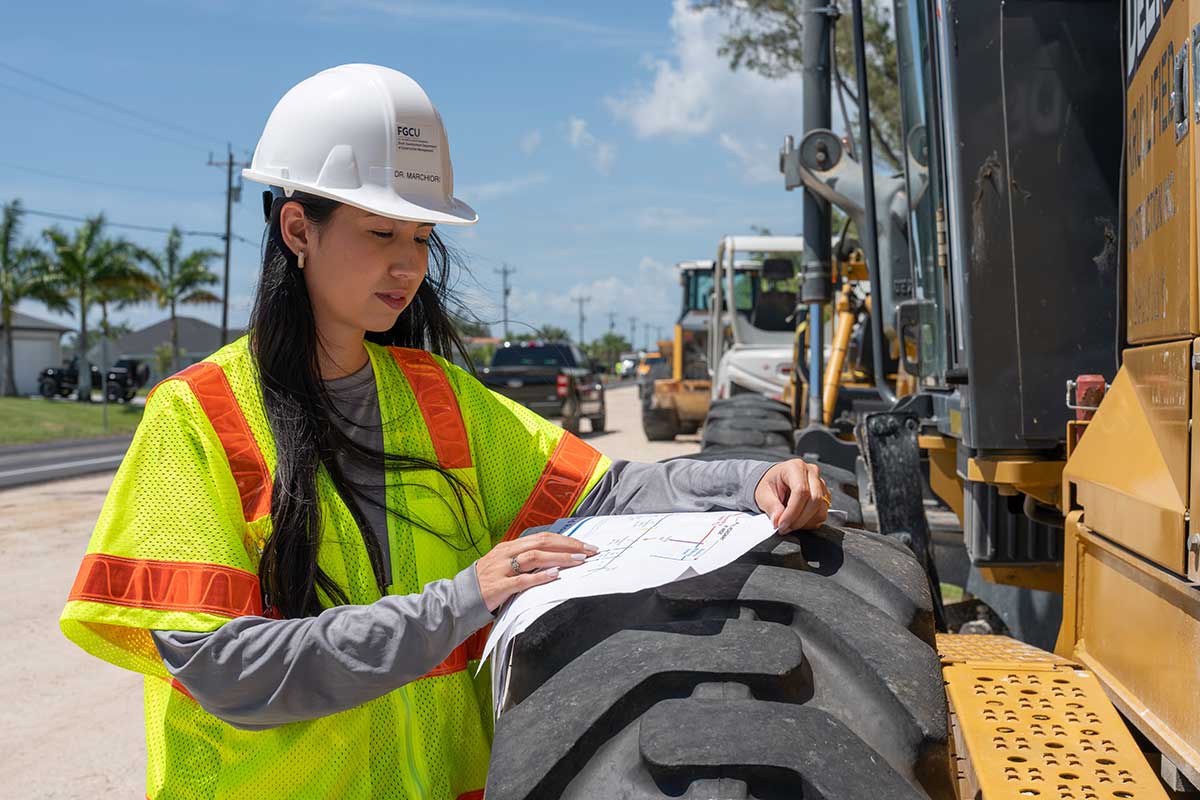
FGCU's Raissa Seichi Marchiori completed a residency with Ajax Paving Industries of Florida.
“Construction management is a very applied field, and industry practices continue to change. These residencies help faculty stay current and bring more real-world examples into the classroom,” Nguyen said.
“Students will benefit from updated lectures, case studies, assignments and projects based on actual construction operations. They may also gain greater exposure to current estimating and scheduling practices, project coordination, safety, quality control and construction technologies,” he said. “Ultimately, the goal is to help our students graduate better prepared for internships and full-time employment.”
The program is expected to generate new partnerships that could result in additional opportunities for student internships with participating companies, guest speakers, construction site visits and industry-supported class projects, Nguyen said.
Marchiori teaches a range of construction engineering and management courses in the U.A. Whitaker College of Engineering.
Trading classrooms for construction sites
The first two faculty participants in the program — assistant professors Anh D. (Andy) Chau and Raissa Seichi Marchiori — are now back on campus and sharing their newfound knowledge with students.
Marchiori completed a residency with Ajax Paving Industries of Florida, a company that has been building roads throughout the state since 1981.
After a week of orientation and safety training followed by an introduction to the preconstruction estimating and bidding process, she advanced to hands-on activities in asphalt production, quality control and field operations. There, she observed the complete asphalt paving process from start to finish, including project management, communication with inspectors, earth-moving operations, reading construction plans, technical paving procedures and job-site safety.
For Marchiori, one major benefit of her residency was gaining extensive exposure to the heavy civil construction sector.
“While students are introduced to many aspects of construction throughout the curriculum, heavy civil projects offer unique processes, technologies and operational challenges that provide valuable additional learning opportunities,” she said.
“Through this experience, I developed a much deeper understanding of asphalt paving operations, plant production, estimating, quality control, fleet management and field operations, which I can now integrate into my lectures.”
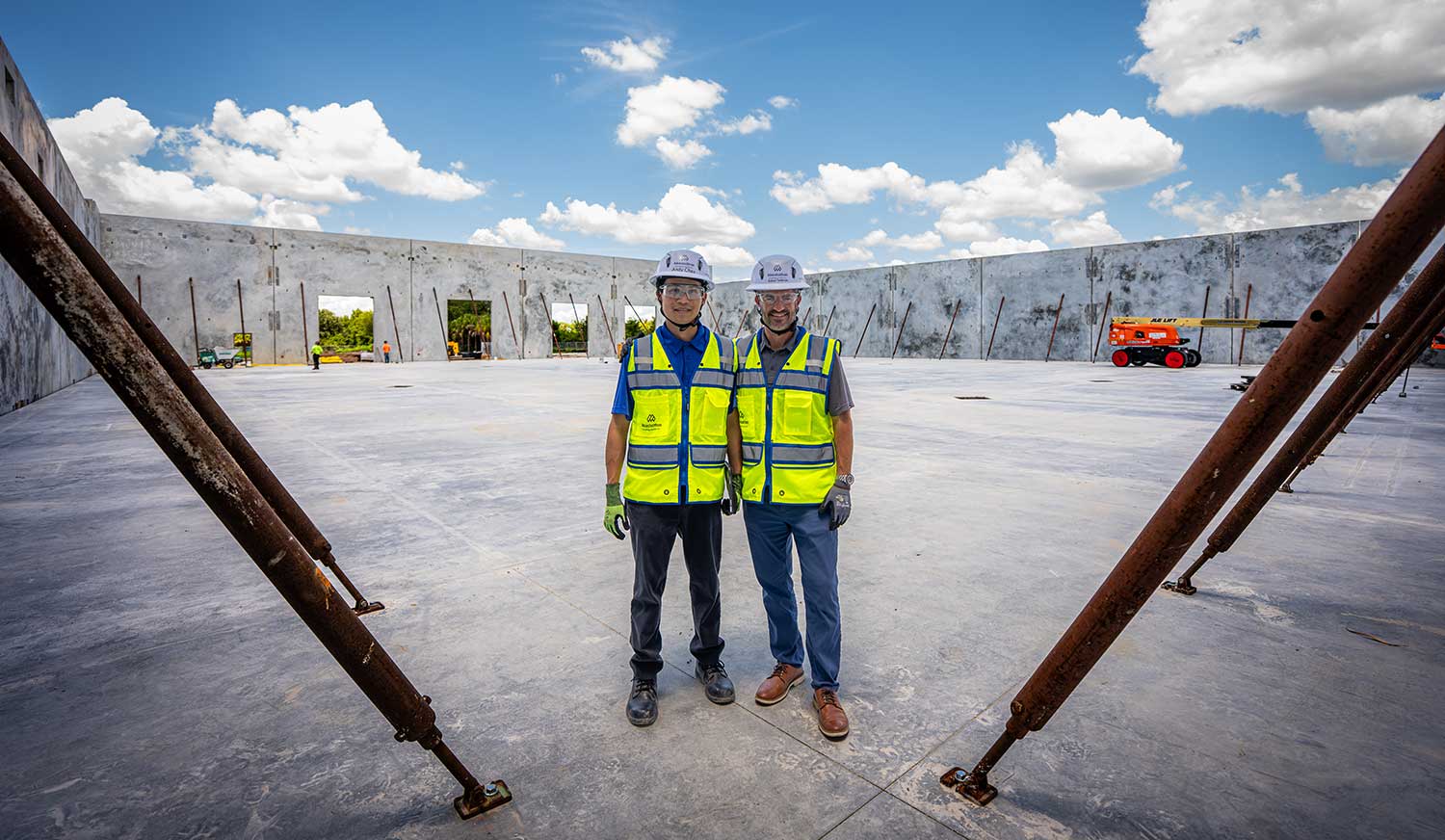
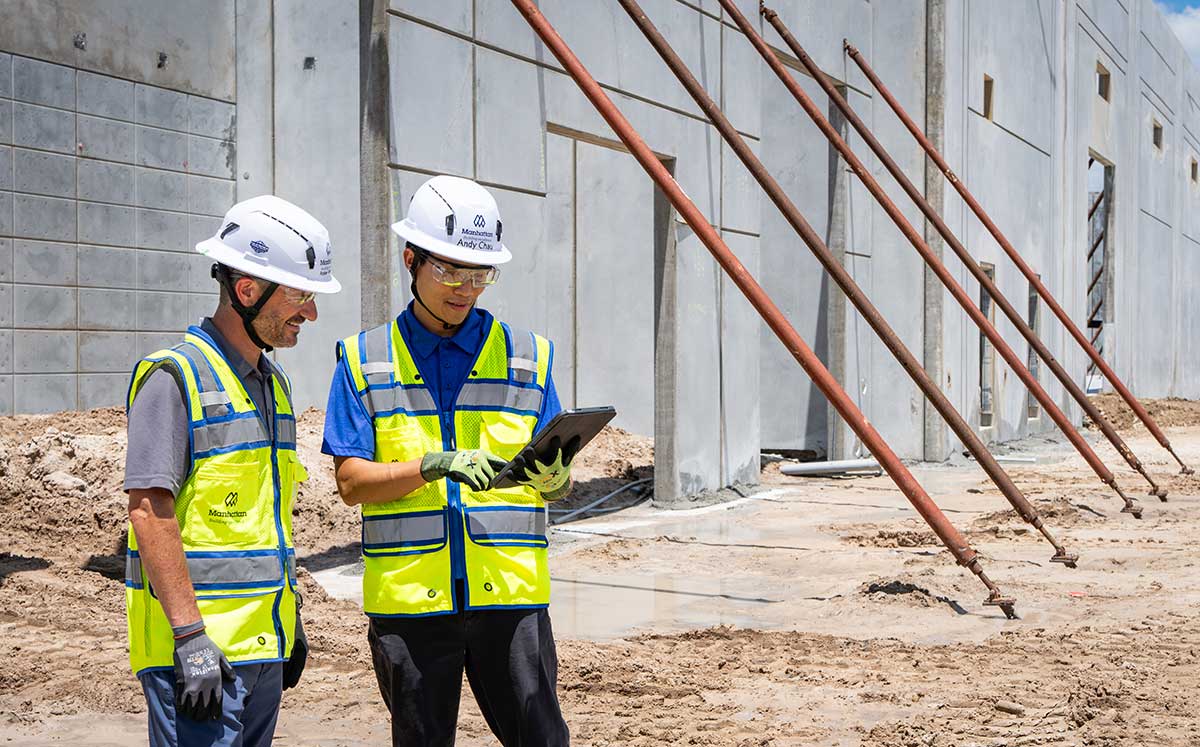
Chau’s residency was with Manhattan Construction Co., where he was based at the project office for a terminal expansion at Southwest Florida International Airport in Fort Myers. Over the summer, he worked on construction scheduling for a Sanibel fire station project and a student housing development. He also reviewed and adjusted bids for a construction manager-at-risk industrial development, where he worked on more than 100 subcontractor proposals in a process called bid leveling.
“The bid leveling covered many specialty trade packages, including finish carpentry, painting, doors and hardware, waterproofing, building insulation, flooring and tile, appliances and engineered metal trusses, going beyond the typical packages I teach in class,” Chau said.
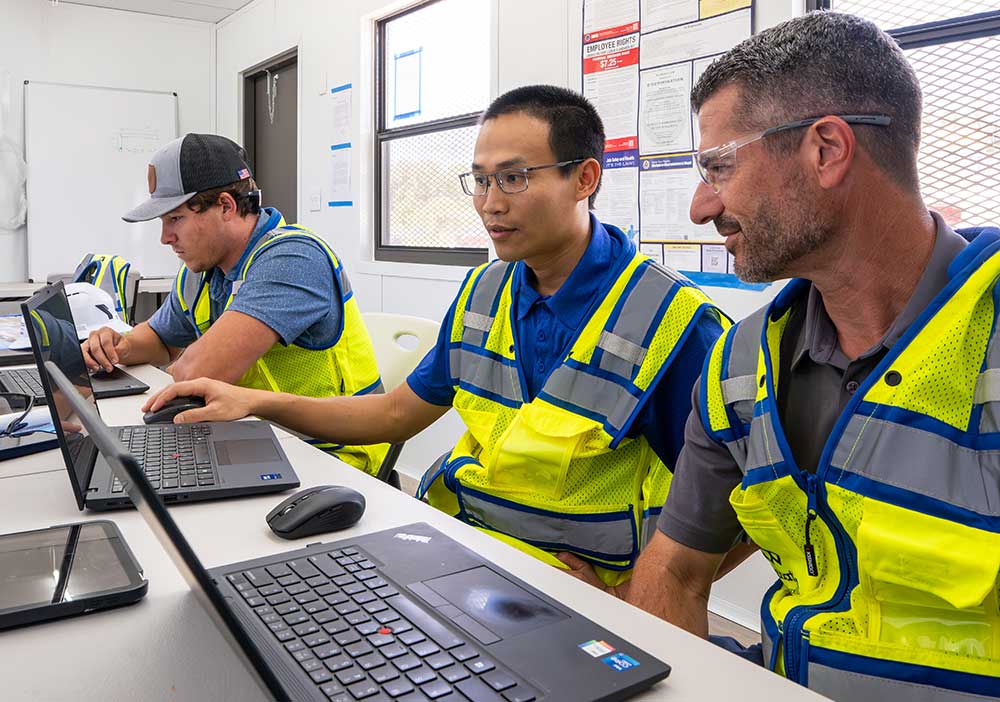
Chau and Tiedeman review plans in a construction site office.
“This was invaluable exposure. I learned how to write subcontractor contracts, when to use short-form versus long-form agreements, how to write clear inclusion and exclusion criteria and how to read specifications more effectively to capture the correct scope in the contract.”
For Chau, perhaps the most meaningful part of the residency was seeing many former students who are now alumni succeeding at Manhattan.
“Beyond my own experience, I believe this program is a great model for construction education. It does more than update one faculty member’s skills. It puts professors back on active job sites, where the industry is evolving faster than any textbook can capture, and it strengthens the partnership between our program and the construction industry in Southwest Florida,” he said. “Every example, case study and lesson I gathered will reach hundreds of students over the coming years. That is a remarkable return on a single summer.”
Manhattan Construction is a longtime partner of FGCU.
‘A two-way exchange of knowledge’
This is undoubtedly beneficial for FGCU’s construction management program and the U.A. Whitaker College of Engineering. But what’s in it for industry partners who provide residency opportunities to faculty?
Robbie Tiedeman, project manager at Manhattan Construction, believes strong partnerships between industry and academia are essential to developing the next generation of construction professionals.
“One of the greatest benefits to industry is the opportunity to create a two-way exchange of knowledge. Faculty gain a deeper understanding of current project delivery methods and industry challenges, while companies gain valuable perspectives from educators and researchers,” Tiedeman said.
“That collaboration drives innovation, strengthens academic programs and ultimately produces graduates who are ready to meet the evolving needs of the construction profession,” he said.
The residency initiative developed from feedback FGCU received during the initial American Council for Construction Education accreditation of the construction management bachelor’s degree during the 2022-23 academic year and received strong support from the department’s Construction Industry Advisory Board, according to Nguyen.
“We hope to build on this inaugural year and make faculty industry residencies a continuing part of our department’s commitment to educational quality and workforce readiness,” he said.