Chengyi Qu teaches Florida Gulf Coast University students how to be hackers — in a good way.
An assistant professor in computer science, Qu is the director of FGCU’s EagleCyberNest Cybersecurity Experiential Learning Lab, where students have the chance to work on some of today’s most pressing cybersecurity issues.
“We study how to protect everyday smart devices — like home cameras, doorbells, health monitors and connected appliances — from cyber threats,” Qu said about the lab’s work. “These devices, often called the ‘Internet of Things’ (IoT), are becoming part of daily life — but many are not designed with strong security in mind.”
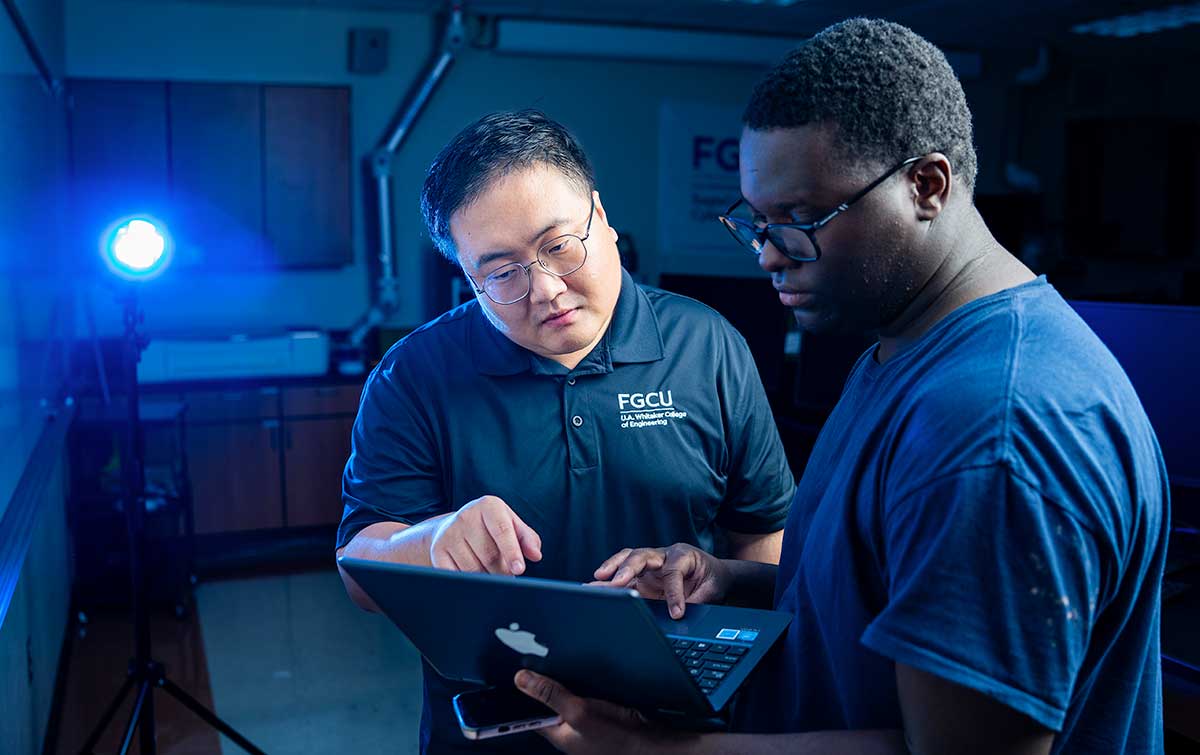
Chengyi Qu works with Richardson Jacques in FGCU’s EagleCyberNest Cybersecurity Experiential Learning Lab.
Qu joined FGCU in 2023 to teach cybersecurity courses and help build out the university’s computer science bachelor’s and master’s programs. He realized that with the computer science industry so in flux, the best way to supplement students’ classroom learning and remain on the cutting edge of cybersecurity was to give them hands-on experience.
Under his guidance, nine students have been working on projects dealing with financial technology, protecting senior citizens from hackers and artificial intelligence scams and how to utilize quantum computers transportation systems. And as a part of identifying system vulnerabilities and creating new programs, students must learn how to engage in what’s called “ethical hacking.”
One of those students, Sean Peppers, won two awards at an ethical hacking debate competition last fall. He describes ethical hacking as being a situation in which “all parties are agreed and have consented to this so that you are able to ensure that their system is more robust.”
“Obviously, there’s no way of making a perfect system. But if you have an attacker go in it, then you can better understand where your vulnerabilities might be,” said Peppers, a computer science major who focuses on intelligent systems, networking and cloud security as a Work in Scholarly and Experiential Research scholar.
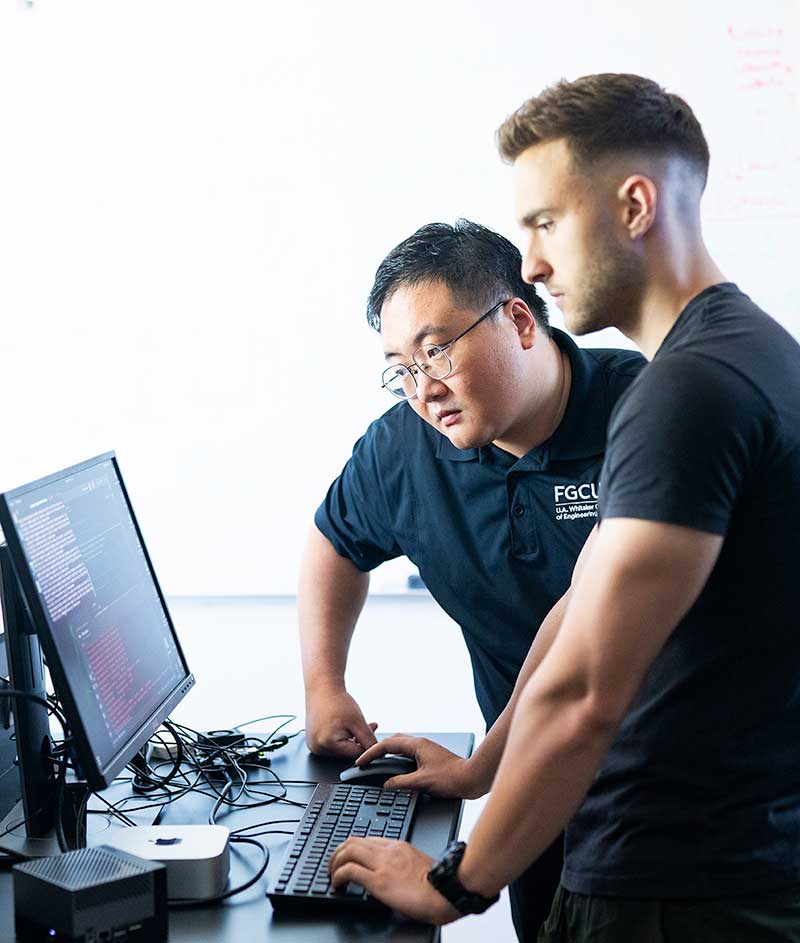
Chengyi Qu works with Paulo Drefahl in the EagleCyberNest Cybersecurity Experiential Learning Lab.
Putting research into action
Artificial intelligence is rapidly transforming the job market, particularly in computer science. Students working in the EagleCyberNest learn how to use AI tools to detect potential security breaches. It’s a practical cybersecurity decision — AI can be more efficient than some traditional cybersecurity tools — and it’s good preparation for students’ post-college professional career, considering AI is likely to continue to grow in importance.
“First, from the student perspective, we want them to get opportunities in this job market,” said Qu. “And cybersecurity is so involved. There are human decisions as we are actually fighting with hackers. So we still need some human in the loop to give them more policymaking and decision-making.”
The research students conduct isn’t just theoretical or restricted to the classroom. Already, several have published conference and journal papers on cybersecurity. And in May, Peppers and classmates Adil Zaben, Jeremy Goldberg and Katharine Ringo also won the inaugural eMerge Hackathon organized by the U.S. Army and the University of South Florida. They beat seven teams from other Florida universities by developing a cybersecurity “honeypot” program that fools hackers into thinking they’re successfully stealing data.
“I’m acting as an adviser, but I think I’m not hyping them too much,” said Qu, who said he was very proud of the team’s win.
“It was only two days or 48 hours of coding,” Qu said. “And the students are also presenting in front of the Army Research Lab and also the different experts in Amazon Web Services.”
EagleCyberNest also conducts state-funded cybersecurity clinics at which they train public and private sector workers on how to protect their systems from cyberthreats. Qu says he hopes to expand those clinics in the coming years, depending on how much funding the state makes available.
For all the interesting research and career-enhancing opportunities the lab provides students, for many involved it’s the people in EagleCyberNest that make it such a positive experience.
Peppers transferred from the University of Central Florida to FGCU in 2024, attracted by the small class sizes in computer science and what he calls a “community driven environment” where students can get to know professors on a first-name basis.
He described getting to know Qu as one of the most rewarding parts of EagleCyberNest.
“He’s a phenomenal mentor. I like that he pretty much lets you do your own thing, and then he’ll only step in whenever you do need that help. So it gives you a lot of your own experience and autonomy during the research process,” said Peppers.