An educational exchange program between Florida Gulf Coast University and a sister institution in Hungary offers future teachers opportunities to experience the differences and similarities between schools half of a world apart.
Through the College of Education, students from FGCU traveled to Eszterházy Károly Catholic University in Eger, Hungary, during the fall 2025 semester, while students from Hungary came to Southwest Florida this spring. The participating students were guest teachers in elementary schools in their host countries, conducted research with faculty, explored new cultures and engaged in community service.
The exchange is now in partnership with Erasmus+, an initiative of the European Union. However, its roots go back 18 years as the brainchild of Tunde Szecsi, FGCU professor of early childhood education. She previously taught at Eszterházy.
“I am Hungarian by nationality, and I used to be a faculty member at that university before I came to the United States,” Szecsi said. “In 2008, we had an idea that we would like to expand our students’ international opportunities, so I offered this connection with my former university.”
To Diana Cheshire, the college’s dean, international exchange provides an important opportunity for future educators to see teaching, learning and community through a broader lens.
“Whether our students travel abroad or students from other countries come here, these experiences deepen understanding and strengthen preparation,” she said.
Liana Clemens visited Budapest during her study abroad experience in Hungary. Photo submitted.
Students immersed in the country
The program’s first 15 or so years were a one-way street. Every two or three years, about 10 FGCU students would spend three weeks studying at Eszterházy’s Jászberény campus, which focuses on teacher training and education studies.
A couple of years ago, Eszterházy faculty approached Jackie Greene, the FGCU faculty member who led the exchange effort at the time, and invited her to apply for a grant with Erasmus+ that would allow Hungarian students to travel to Florida and students from FGCU to visit Hungary.
Upon Greene’s retirement, Szecsi assumed responsibility for the program.
“The most important part is the real student exchange. It is about visiting schools, teaching in schools and being immersed in the community. It is a great opportunity for FGCU students to learn about another country, another culture and another education system, which happens to be a really good education system,” Szecsi said.
“It’s the same for the Hungarian students who come here,” she said. “In addition to taking courses, they tutor and teach in an elementary school, and they were invited to do presentations about children’s literature in Hungary. It was a very enriching experience for them because they had a chance to travel a little bit and explore Florida.”
Erasmus+ covers all costs, with FGCU’s Global Engagement Office and College of Education providing on-campus housing for Hungarian students.
Understanding students learning new languages
For FGCU student Liana Clemens of Cape Coral, the program allowed her to combine two lifelong ambitions: becoming a teacher and traveling internationally.
“During my semester abroad, I learned so much about education in different parts of the world. Here, we see mostly the same tactics and teaching styles, so it was very interesting to see how things were done in Hungary,” Clemens said.
“What surprised me was that not only are there many cultural differences, but there are also a lot of differences in the classrooms. For one, technology is not used as frequently. They do not rely on it as much as we do in America, which was very interesting considering we are surrounded by technology everywhere we go,” she said.
The experience will help her as she begins her career because it provided her with a better understanding of what it is like to be a student learning a new language in a foreign country, Clemens said.
“In most of my courses, we discuss teaching English to speakers of other languages, so it was interesting to be on the other side — being the student unfamiliar with the language and area,” she said. “In my future classroom, I will implement strategies I learned to make sure any English language learners feel safe and comfortable so they can be confident in themselves and grow and learn.”
Adapting teaching methods for Hungary
Hungarian student Dora Fehérvári, a junior, applied for the exchange program to prepare for teaching English to elementary students in her home country.
“This gave me the opportunity to practice my English with foreign students in a very efficient way,” Fehérvári said. “Also, I am interested in how the education systems work in the United States, and I am writing my thesis at home about this topic. Lastly, I wanted to explore America’s culture a bit more.”
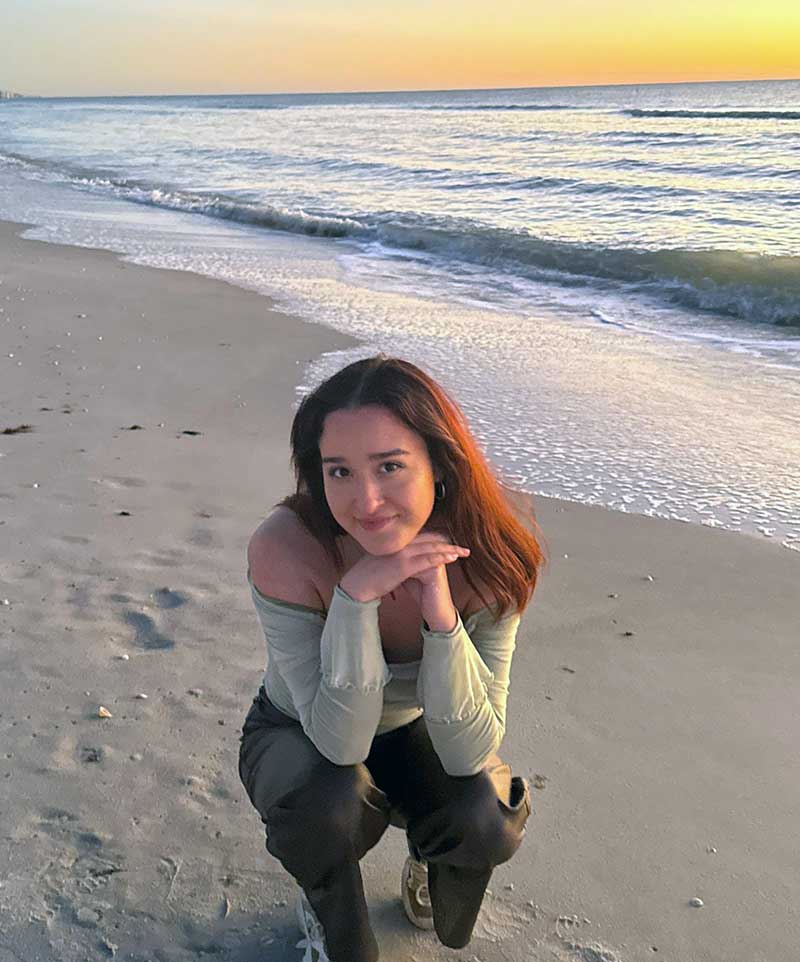
Hungarian student Dora Fehérvári enjoyed some beach time during her semester at FGCU. Photo submitted.
She’s taking the lessons learned in Florida schools home to use in her own classrooms after graduation.
“I learned a lot in Florida because our education system is really different. The classes I took inspired me, and I want to adapt some methods into the teaching I do in Hungarian elementary schools,” Fehérvári said. “I learned how to communicate better with parents, how to maintain students’ attention during the lessons, how American schools celebrate different holidays and how I can use different methods with different age groups of kids.”
For Fehérvári, the most unexpected thing she experienced was the sprawling nature of America. “Distances are so big in the United States that it is very hard to travel anywhere without a car. In Hungary, everything is at a walking distance, and we have a lot of public transportation like buses, trams, trains, subways and more,” she said.
“What I really liked living in Florida is that the people are really helpful, open and friendly and are not quick to judge,” Fehérvári said.