Florida Gulf Coast University senior Danielle Baynum grew up as a self-described “Navy brat” in a long line of veterans. Born in a military hospital, she practiced saluting in a mirror as a youngster and went on to serve six years in the U.S. Navy as a nuclear technician.
When the time came to re-enter civilian life in 2007, Baynum struggled to find a path into higher education and a new career. Asking for help felt contrary to the mindset ingrained by military culture.
“People don’t realize how difficult it is to transition out of service,” says Baynum, who’s also a first-generation college student. “It’s a huge culture shock. You kind of lose a sense of purpose. I truly recommend if a veteran is struggling at all, they need to find as much support as they can.”
And they can find it at FGCU.
As the university honors those who served this Veterans Day, it also celebrates its designation earlier this year as a Florida Collegiate Purple Star Campus, a testament to FGCU’s comprehensive benefits and services for veterans and military-connected students. These include priority course registration, a designated military liaison, resources for military students and families, student-led transition programs, and professional development and training opportunities. The Purple Star program was established in 2023 by the Florida Legislature.
Some members of FGCU’s Student Veterans of America chapter met for a "Mid-Month Muster" recently in the the Office of Military & Veteran Success. The suite provides a place for networking, studying and socializing.
For years, FGCU has dedicated staff and online resources to provide assistance with Veterans Administration education benefits, offered early class registration and hosted an active student-veterans organization. The two latest initiatives launched by the Office of Military & Veteran Success are: the Peer Assistance for Transitioning Heroes (PATH) program offering veteran-to-veteran mentorship to support military-connected students as they adjust to college and civilian life; and a professional development training to educate faculty and staff about military culture and student veterans’ unique needs.
“Those two were the missing pieces of what we needed to get Purple Star Campus designation,” says Sylvia Mitchell, interim director of Military & Veteran Success, which is in FGCU’s Community Counseling & Education Center. The wife and mother of veterans, she has been helping service members and their families navigate the academic environment at FGCU since 2011.
“It’s important that they know we serve as a resource, providing community and getting them engaged with other campus partners to ensure their success.”
Navy veteran Danielle Baynum is vice president of SVA and coordinates the PATH mentorship program.
Mitchell estimates 350-400 service-connected students are enrolled at FGCU at any given time. They tend to gravitate toward each other and help each other, she says, because they “speak the same language.”
That’s part of what inspired the new peer-based program, which Navy veteran Baynum coordinates as vice president of FGCU’s Student Veterans of America chapter. Prior to attending FGCU, the accounting major had worked in employment and social services for veterans through the United Way and other agencies.
“PATH is a student-run peer mentorship program,” Baynum says. “Whether you’re a veteran or a dependent, we connect our experienced students who know the ropes of navigating campus resources with students who are either struggling or just in need of some mentoring.”
Among the program’s seven mentors is U.S. Coast Guard veteran Lauren Rodriguez, a senior exercise science major. When it comes to trying to find resources, support and community on campus, she has walked in the boots of today’s incoming veterans. Rodriguez ultimately became deeply involved with the Military & Veteran Success office and is now president of Student Veterans of America, an organization that welcomes non-military-connected allies as well as veterans.
“We’re implementing different strategies at Eagle View Orientation, showing our presence and making sure that before a student veteran even arrives, they know where we are,” Rodriguez says.
“I’m very pleased to see that FGCU is actually a military-friendly campus, and I’m proud to say that it is.”
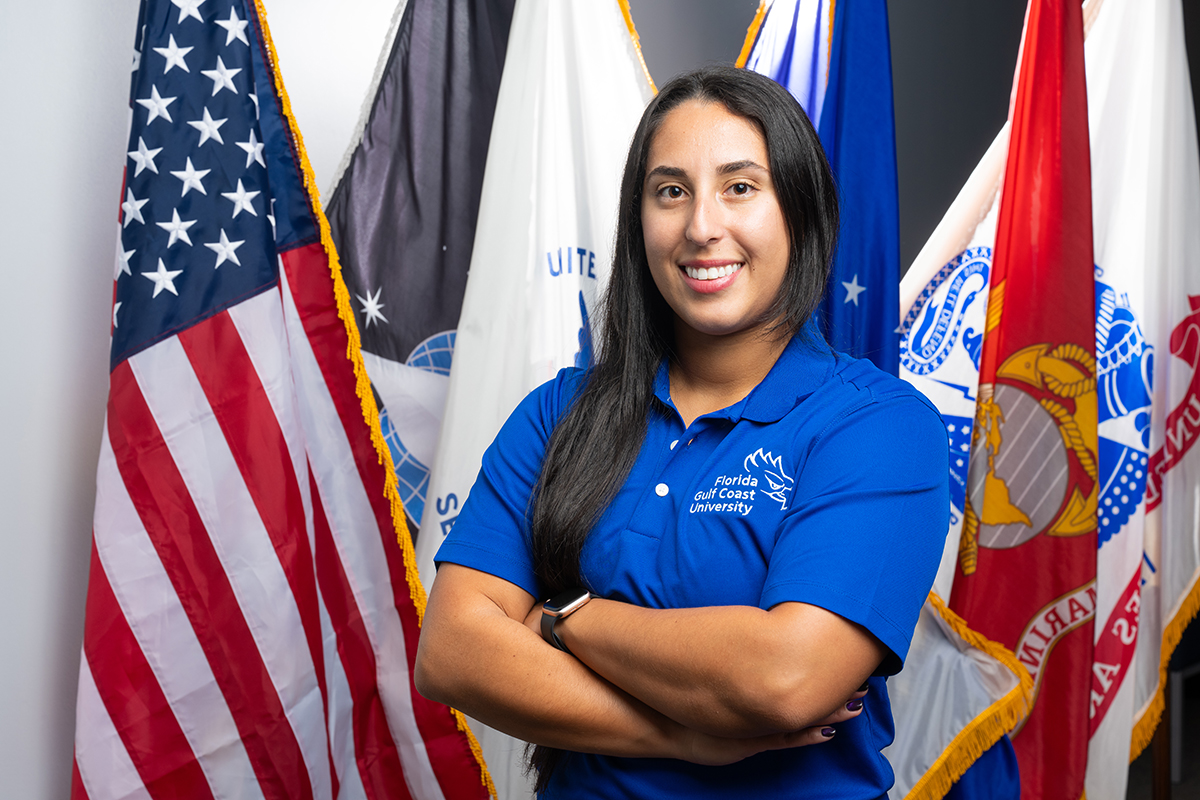
Lauren Rodriguez is a U.S. Coast Guard veteran and president of SVA.
Another facet of FGCU’s commitment to veterans’ success is represented by its on-campus partnership with Home Base Florida since 2014. The nonprofit helps veterans heal the invisible wounds of war — such as post-traumatic stress disorder, traumatic brain injury, anxiety and depression — through clinical care, training, wellness services and research. It’s currently based in the Kleist Health Education Center.
“Home Base helps support the mind, the body and, in a way, the soul of the individual coming through,” says Joe Buhain, an assistant professor in Marieb College of Health & Human Services who is a veteran, active Florida State Guard member and faculty adviser for the Student Veterans of America chapter. “So FGCU has not only the educational aspect to offer but the mental and physical well-being support, too. That has an extraordinary effect.”
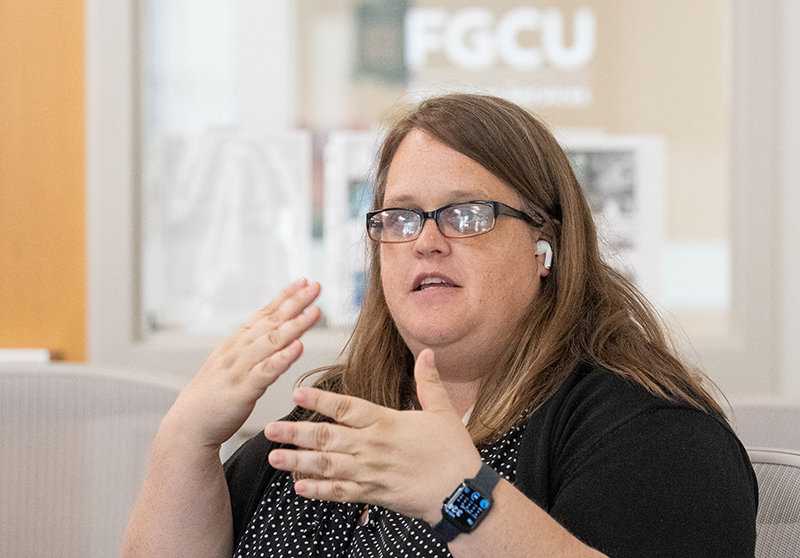
Air Force veteran Jonathan Argueta, from FGCU's Internships and Cooperative Programs office, spoke at the Mid-Month Muster.
Another on-campus program connecting veterans from off campus to FGCU is the Veterans Florida Entrepreneurship Program. Housed in the Daveler & Kauanui School of Entrepreneurship, the comprehensive, tuition-free training experience supports participants at all stages of their entrepreneurial journey, from idea development to scaling established businesses.
FGCU’s commitment to those who’ve served is poised to expand significantly in the future. The university has developed plans to build a privately funded veterans center on campus to serve FGCU students and the wider community. The facility would act as a hub for academic, professional and wellness support, enhancing direct services for military-connected students, faculty and staff as well as veterans and their families from the surrounding community. It’s estimated that 94,000 veterans live in Southwest Florida.