Florida Gulf Coast University took another transformative step toward preparing more future-ready healthcare graduates at the April 15 groundbreaking celebration for Academic Building 10, now known as Marieb Hall South.
The four-story structure — an expansion of Marieb College of Health & Human Services — will house 158,040 square feet and become the largest academic building on campus. Construction is scheduled to begin in May on the south campus area between the Arts Complex and parking garage 2, and classes are expected to begin there in spring 2029.
In welcoming guests, President Aysegul Timur described the groundbreaking as an “exciting and historic day” for FGCU and the expansion of health sciences programs as “our next big adventure.”
“We are standing at the beginning of something transformative for our university, for Southwest Florida and for generations of students who will follow,” she said. “We’re here to launch a facility that will expand opportunity, elevate healthcare education and strengthen the future of our region and the great state of Florida.”
Symbolically turning soil for Marieb Hall South are, from left: Bob Kramer, Skanska vice president; Maurizio Maso, HuntonBrady principal; Javier Salazar, RG Architects principal; Shawn Felton, dean of Marieb College; Stephen Vale, Marieb College graduate; Larry Antonucci, FGCU Board of Trustees chair; Aysegul Timur, FGCU president.
The celebration also served as a reminder that FGCU was built by the community for the community, she said, noting the support of many partners in the audience.
“We are powered by the state of Florida’s investment in workforce needs. We are powered by the advocacy of our Southwest Florida legislative delegation. And we are powered by a community of supporters who believe in what we are doing,” Timur said.
Envisioned as an interprofessional shared training environment, the building is intentionally designed to bring together clinical care, simulation and academic instruction in one environment. The building will allow students from multiple disciplines to train together in spaces that closely mirror real-world healthcare settings.
President Aysegul Timur welcomed guests to the groundbreaking.
“What we’re trying to do is future-proof our workforce for healthcare,” said Shawn Felton, dean of Marieb College of Health & Human Services.
The state-supported project marks a significant milestone in FGCU’s commitment to innovation, interprofessional education and student-centered learning. Marieb’s expansion will also enable the college to enroll and graduate more students to help address urgent shortages of healthcare professionals.
“Interprofessional education is critical in developing healthcare professionals, both clinical and non-clinical, to really foster team-based care — that’s what healthcare is all about,” said Shawn Felton, dean of Marieb College. “They need to understand and learn from each other. That commitment to interprofessional education is critical as we train the future healthcare workforce for Southwest Florida and beyond.”
Community members, faculty, staff, students and alumni gathered for the groundbreaking.
Marieb Hall South will house advanced educational technology funded in part by a $22 million grant from the Elaine Nicpon Marieb Charitable Foundation, the largest cash donation in the university’s history.
The gift, announced in June 2025, enables the college to expand advanced resources that have already contributed to student success — such as high-tech patient simulation labs and holographic-style imaging. Such technology already allows aspiring nurses, physician assistants and other healthcare professionals to practice skills realistically but safely.
“This allows us to embed simulation both in the programs that currently use several areas of simulation, but also those that don’t,” Felton said. “I’m really excited about the utilization of this in counseling, social work and physical and occupational therapy — areas that may have not done as much in simulation.”
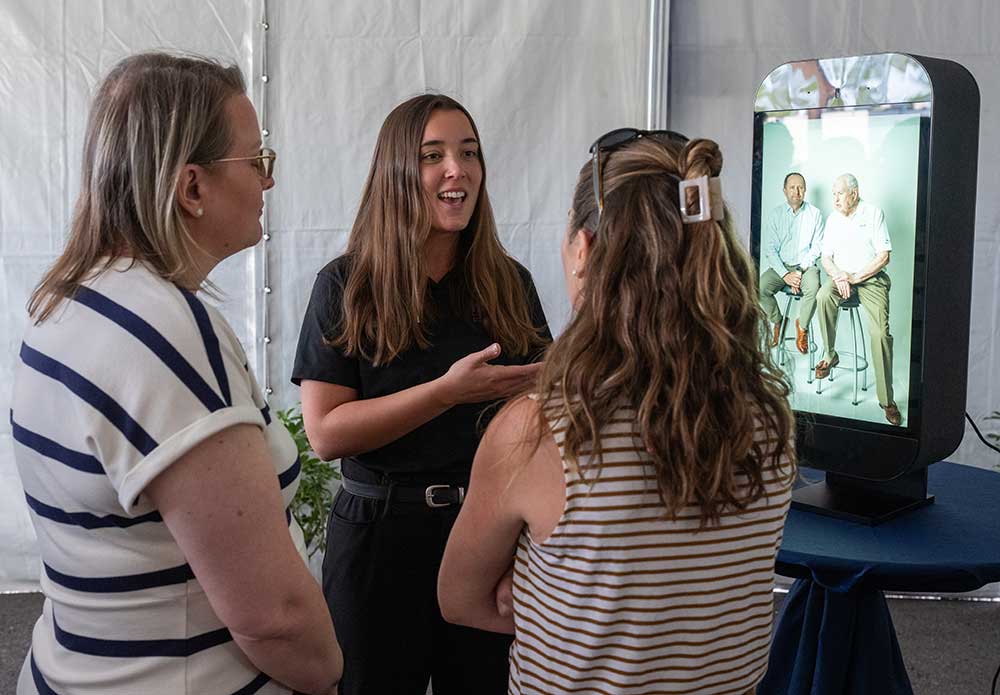
Students talked about some of Marieb College’s technology with guests at the groundbreaking.
Rendering of Marieb Hall South courtesy of RG Architects and HuntonBrady Architects.
The new building will feature an immersive high-resolution laser projection space where students can step into fully interactive scenarios such as disaster response and complex clinical situations, creating a multisensory learning experience unmatched in traditional classrooms.
“This facility incorporates state-of-the-art instructional technologies that elevate experiential learning to a new level,” said Joe Buhain, assistant professor and director of interprofessional simulation and emerging technology. “This building serves as a model for the future of healthcare training by combining advanced simulation design, emerging technologies and real-world clinical integration into a single, cohesive educational ecosystem.”
Simulated operating rooms, intensive care units and pediatric and obstetric suites will create real-world conditions for experiential learning. Functional apartment-style simulation environments will be used for practicing physical and occupational therapy. Centralized control rooms will enable faculty to observe and evaluate training exercises as they happen.
Video courtesy of RG Architects.
“What we’re trying to do is future-proof our workforce for healthcare,” Felton said.
“Technology is rapidly changing almost in front of our eyes. We’re trying to anticipate that and ensure that future Marieb graduates are ready. We talk about the fourth industrial revolution in society, and this is the technology revolution. It’s very important that we’re ahead of the curve, and that’s what we’re focusing on.”
Legislative support critical to project
Research facilities will include a high-tech maker space where students and faculty can design, prototype and test medical devices and healthcare innovations. A fully integrated photo and media suite will support simulation recording, content creation and educational media development.
Marieb Hall South was designed by RG Architects and HuntonBrady Architects. The state approved and funded $117 million for the first phase; $27 million for the second phase is currently in the legislative process.
“We’re so appreciative of the state and the legislators for their support,” Felton said. “We would not be at this point without the great support of the governor, legislators and the Board of Governors. Thanks to the Marieb Foundation as well for seeing what we’re doing to better the healthcare workforce here in Southwest Florida and beyond.”