Which came first for marine science major Zoe Szabo: her passion for diving or for underwater photography and videography?
She says they probably came together in an inspiring package deal. Szabo grew up watching nature documentaries on National Geographic and Discovery. The underwater videography entranced her — especially when it involved Cristina Mittermeier and Paul Nicklen, a husband-wife team who use modern technology to raise awareness about climate change and environmental issues.
One problem: She was living in Indiana, where diving opportunities are essentially non-existent. But when she moved to Florida to attend Florida Gulf Coast University, she knew she needed to get diving as soon as possible.
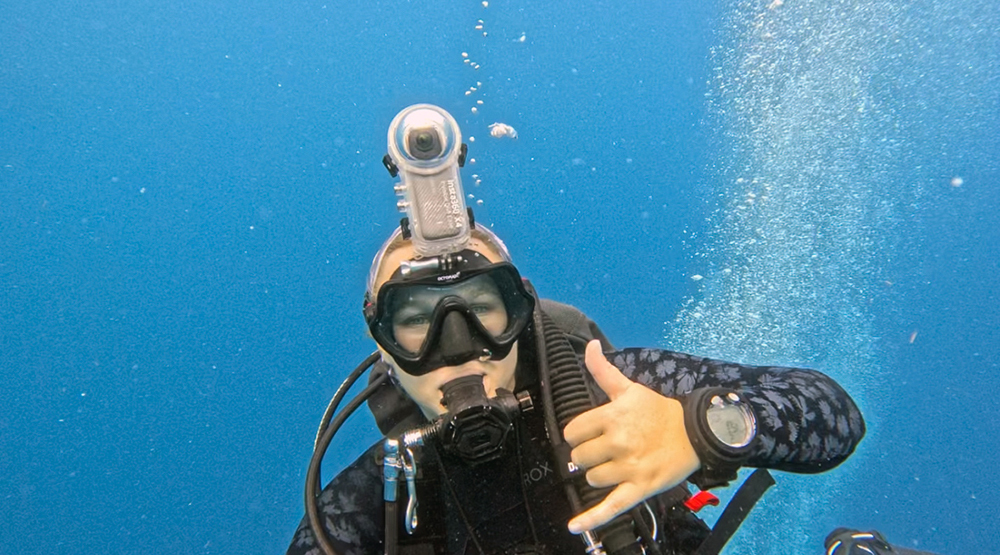
Zoe Szabo mounts a camera on her mask to shoot 360-degree underwater video.
“More diving meant more opportunities to do underwater photography and videography,” she says.
She seized those opportunities and ran — or more accurately dived — with them.
“Zoe is a student who consistently elevates her environment,” says Calli Johnson, who serves as The Water School’s dive safety officer and was Szabo’s instructor for the Scientific Diving course last spring. “She brings curiosity, reliability and leadership to every project, from virtual reality (VR) module development to fieldwork support, even with a dose of humor. Zoe anticipates needs, solves problems before they reach others and produces work marked by maturity and technical skill. She is exactly the kind of student you hope to have: capable, collaborative and deeply committed to the success of the team.”
Johnson also works in marine science professor Michael Parsons’ lab studying harmful algae blooms, where Szabo has been a research assistant focusing on underwater photography and videography since her first year at FGCU. The two women meshed so well that they were able to develop a funded project called IMMERSIA-VR, which explores using 360-degree underwater video to create immersive VR experiences bringing the world of scientific diving to life.
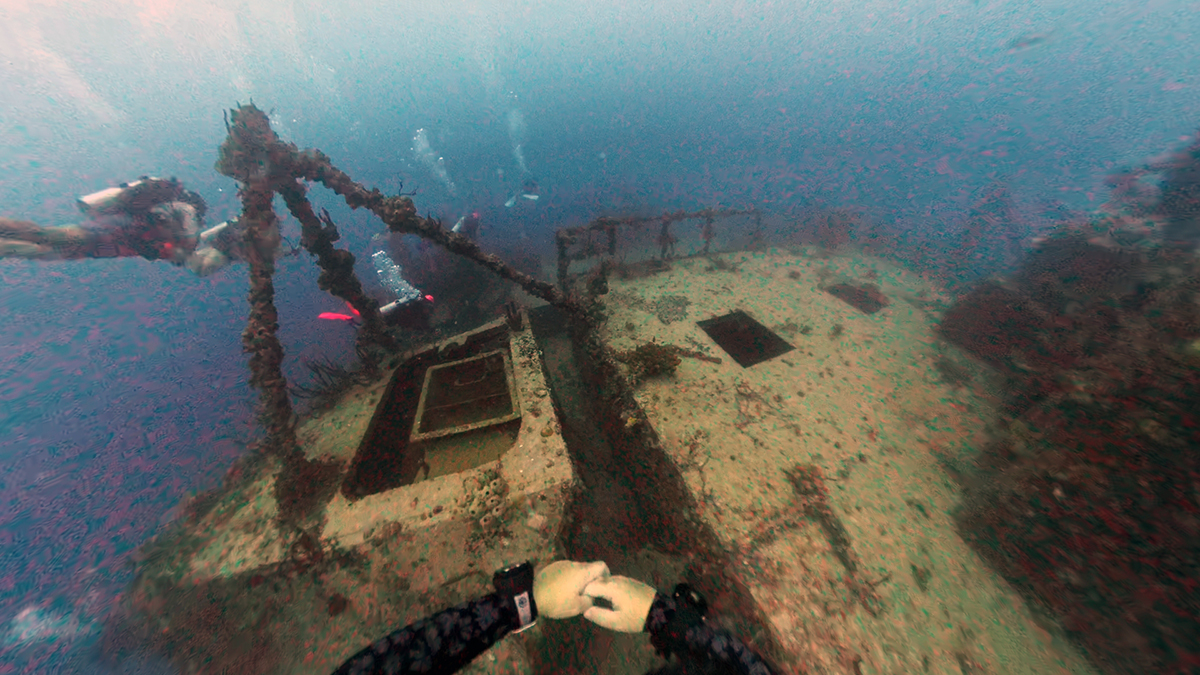
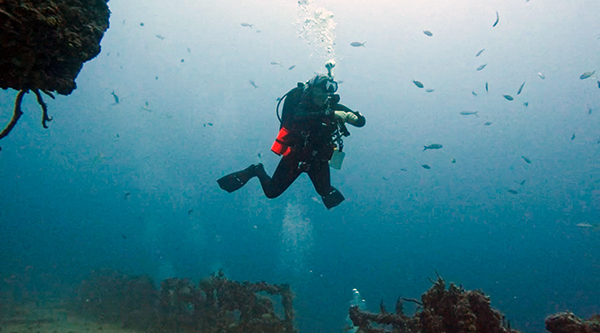
Zoe Szabo shot this video at Kimberly’s Reef, which The Water School built for education, public fishing and scientific research on water quality and marine life.
Experiencing the underwater world
Having experienced some underwater VR videos in the past, Szabo knew the technology could be a useful tool in the already niche field of underwater media.
So, she began mounting an Insta360 X4 camera on her scuba mask as she led students in checkout dives for the Scientific Diving course. The pocket-sized camera enables her to capture high-resolution spherical video that allows the viewer to experience the underwater world through her eyes — an immersive, first-person point of view.
The camera records 360-degree video of the entire dive from entry to exit. The footage is offloaded, edited and processed to fit a Meta Quest 3S headset. Using the headset, viewers can experience a complete scientific dive, allowing them to feel like they are really underwater.
“We have explored, and hope to continue to explore, the opportunities that this technology has in scientific diving both within FGCU and beyond,” Szabo says. “These immersive experiences can be used to help viewers further understand dive site configurations, sampling techniques, expectations and a multitude of other diving-related applications. Outside of scientific diving, these experiences can be shared with non-divers to help promote conservation efforts or even allow those who may be skeptical to get into diving some peace of mind.”
Says Johnson, “This is going to be a revolutionary educational tool for my dive program and others willing to embrace technology. That has often been a challenge in the dive industry, which seems ripe for change.”
Both are also curious about the calming effect these VR dives might have. In the spring semester, they hope to develop a metric to assess how this technology can potentially reduce pre-dive anxiety or enhance diver understanding.
“Giving divers a chance to view a dive from start to finish before they ever even get in the water is a unique experience and may prove extremely revolutionary to further enhance diving as a whole,” Szabo says.
Expanding uses for VR technology underwater
In another Parsons project, Szabo is harnessing underwater photography to study the correlation between seagrass coverage and the abundance of single-celled organisms called dinoflagellates in the Florida Keys. The dinoflagellate Gambierdiscus has been speculated to cause the “spinning fish” anomaly documented in the Keys. Szabo’s work specifically tries to understand the impact that the macroalgae Thalassia testudinum, commonly called seagrass or turtle grass, may have on this issue.
She uses an underwater camera and a 1-square-meter quadrat to take photos of turtle grass coverage along transects at sampling sites throughout the upper and lower Keys. These photos are then analyzed using ID software to determine the percentage of turtle grass coverage at each site, which is then correlated to her Gambierdiscus counts.
“I hope to include IMMERSIA-VR in these sampling processes,” she says. “By using my head-mount rig, I will be able to generate a first-person POV of what real scientific diving and underwater research looks like, further adding to the numerous applications of this project.
“My enthusiasm for underwater photography and videography has driven my life’s goals completely, and I knew I wanted my college experience to reflect that. Moving forward, I hope to continue to share underwater media to help promote education, conservation and outreach — the very things that IMMERSIA-VR is made to do as well.”