Florida Gulf Coast University hosted its second annual Disaster Day Interprofessional Simulation event Nov. 21. The immersive emergency drill involved more than 1,050 individuals, including FGCU students and faculty, volunteer “patients” and representatives from two dozen regional agencies in the healthcare and public safety sectors.
The collaborative event aligns with FGCU’s strategic goals of elevating local partnerships and promoting sustainability and resiliency, according to lead organizer Joe Buhain, assistant professor and director of interprofessional simulation and emerging technology.
“As we say in the military, this is serving the cause — being able to bring a thousand people here to practice emergency preparedness and giving students the opportunity to experience this,” he said.
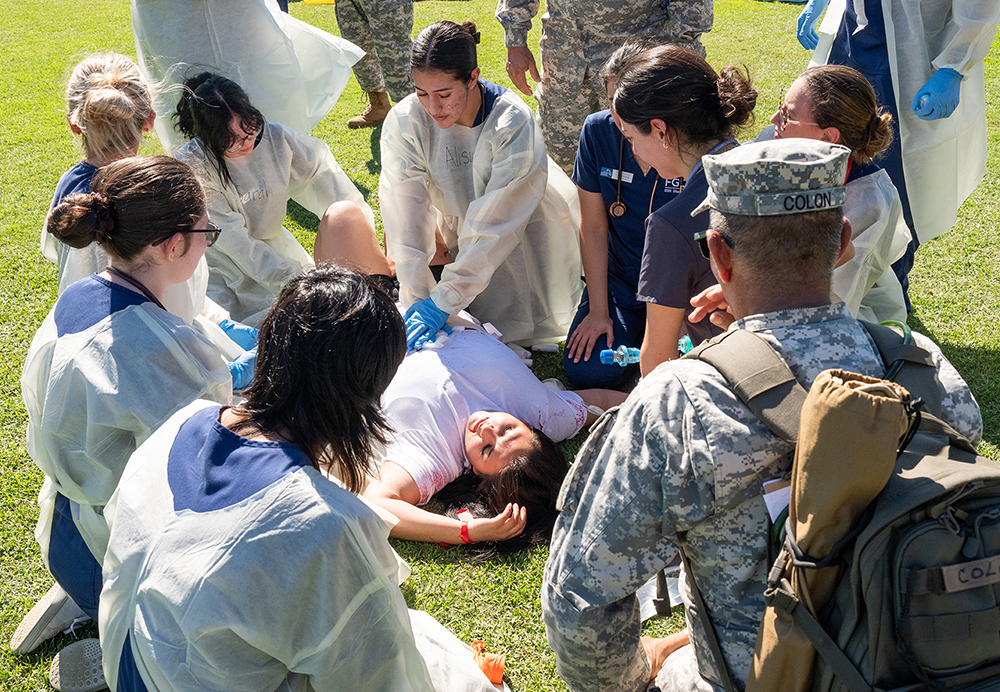
FGUC students and Florida State Guard members treat a simulated "patient" during an emergency training drill on Recreation Field 1.
Ambulances, police cars, fire trucks and a medical helicopter helped create a realistic atmosphere for 270 Marieb students to practice how to respond in a real-life disaster — in this hypothetical case, a devastating hurricane. Faculty and experts from across Florida taught students how best to assess, diagnose, treat and care for patients in a fast-paced, mass-casualty scenario. They reviewed CPR procedures and best methods to stop bleeding.
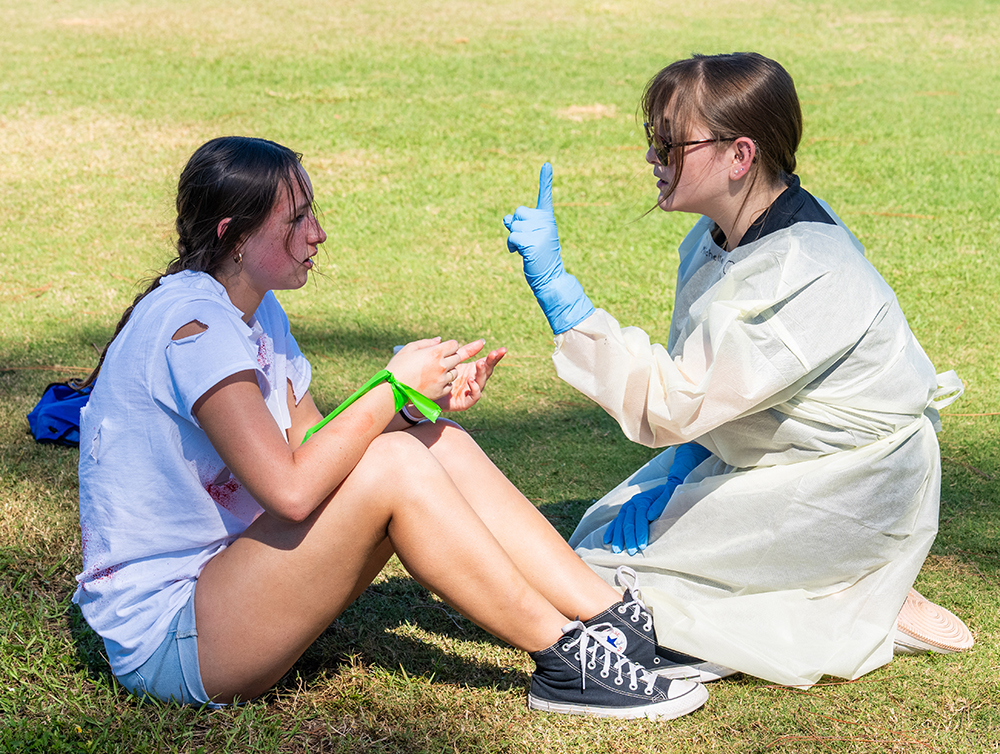
Recreation Field 1 served as center stage for Florida State Guard members and FGCU students to triage 300 would-be victims scattered across the field and sporting fake injuries and blood. While a few were manikins, most were volunteers pretending to be dazed or screaming for help while others were hearing impaired and needed sign language translation. Together, FGCU students and first responders assessed patient conditions.
“You have to decide as a team which patients are most likely to survive and which are most appropriate to get transportation with limited resources at hand,” Courtney Pledger, an assistant professor in the physician assistant program, told students in a patient assessment workshop before the simulation began.
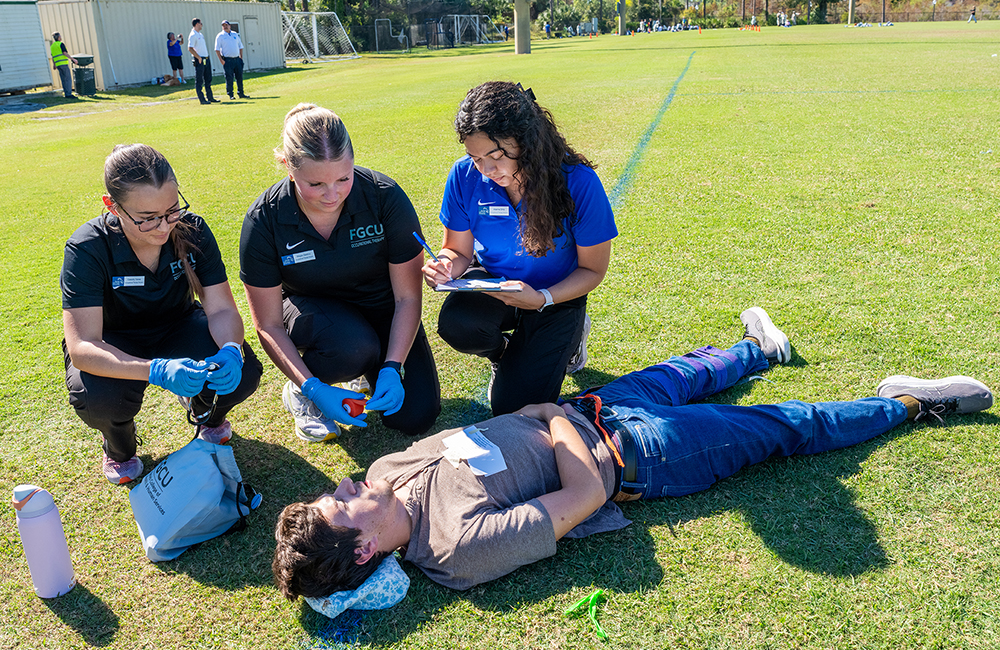
Marieb College students were responsible for assessing the physical and mental condition of volunteers simulating injuries during the mass-casualty exercise.
Another training session led by Ariella VanHara, clinical assistant professor in social work, reviewed mental health evaluation. “Everyone responds to crisis differently,” she said. “You have to treat everyone based on how they’re presenting and the best way to support them.”
Disaster Day is just another example of how FGCU is providing a transformative, learner-centered education to ensure students are workforce ready. Disciplines taking part in the hands-on experience included nursing, physical therapy, physician assistant studies, occupational therapy, social work, performing arts, public health, exercise science, counseling and clinical lab sciences.
The goal of this exercise is to engage students in interprofessional education with the hope that they learn, not just from the event, but from each other. After treating a simulated brain bleed and applying a splint to a leg injury, senior nursing major Abigail Walter high-fived team members and described the experience as “fun.”
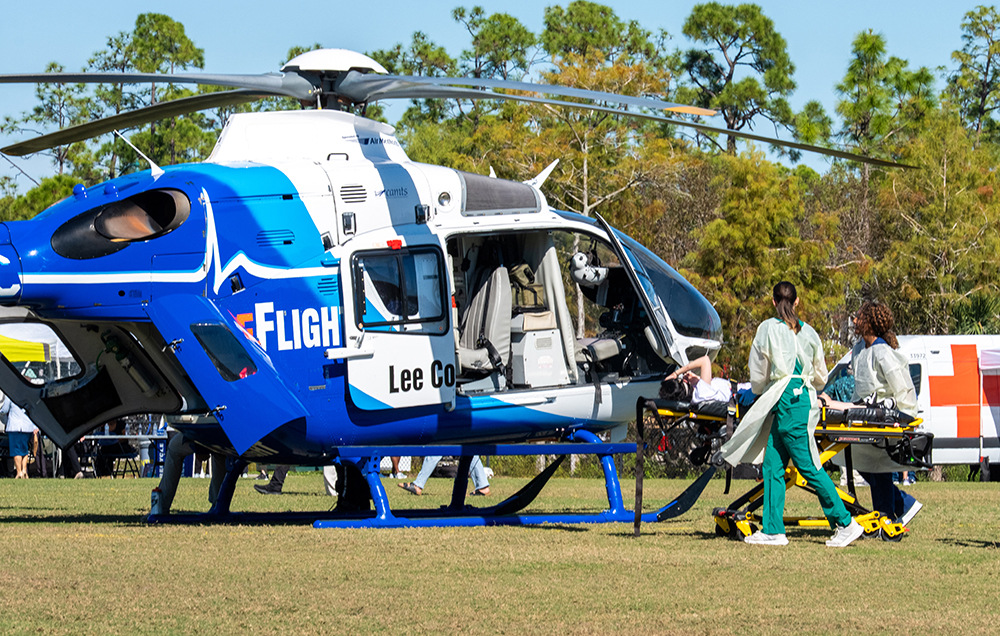
A Lee County EMS helicopter landed on Recreation Field 1 during the Disaster Day simulation.
“It’s a little overwhelming at first, but once you get in the groove you just start putting everything you’ve learned to use,” she said. “It’s a good feeling to know you can be useful.”
Fellow nursing senior Peyton Webb added, “It was great to collaborate with different agencies and speak with people we’re going to work with in the community.”
This included representatives from Lee Health, NCH, American Red Cross, Salvation Army and area fire and EMS services.
“It’s crucial for everyone to be prepared for disasters like hurricanes, but we can’t do this work alone,” said Dariana Molino, Red Cross regional communications manager. “It’s good for (students) to get to know these organizations. They are the future of our community.”
Lucas Karth, EMS division chief for San Carlos Park Fire & Rescue, helped lead a Disaster Day presentation in the Cohen Student Union about rapid patient assessment in emergency situations.
“Events like this show the importance of collaborative partnerships between the university and the community,” he said.
Paws on the front lines
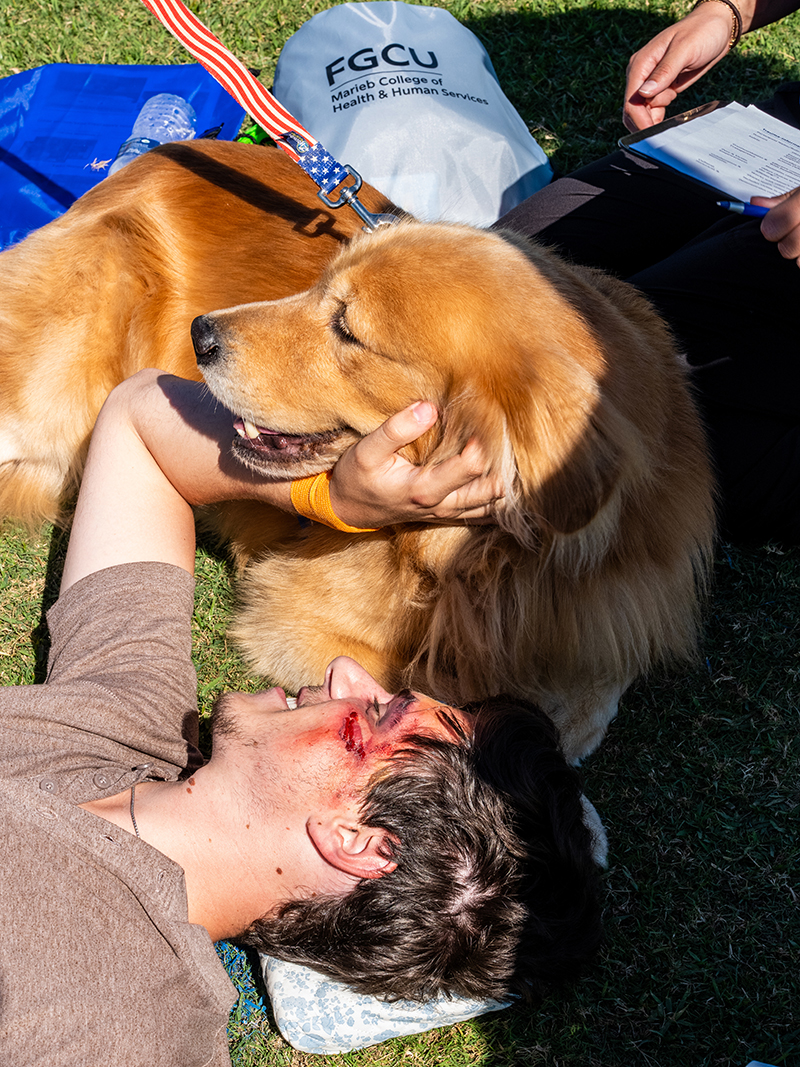
Canine caregivers also joined Disaster Day. Bridget Belanger, an assistant professor of occupational therapy, is a veteran who worked with combat stress dogs in Iraq and Afghanistan. Certified in animal-assisted crisis response, she specializes in human-animal therapy. For Disaster Day, she arranged for five volunteer handlers from Beesley’s Paw Prints — a pet-therapy organization — to bring their dogs to FGCU.
The event gave handlers a chance to practice skills essential to animal-assisted crisis response. It also gave FGCU students a chance to see firsthand how therapy animals can make a difference in high-stress situations, Belanger said.
“For the handlers, your job is the dog. For the students, their job is the victim,” Belanger said.
Her students would determine which psychological and cognitive injuries could benefit from an animal-assisted intervention. Dogs did not interact with patients portraying open physical injuries, mirroring real-world precautions to prevent infection.
“We know the therapeutic effects of placing an animal in a disaster,” Belanger said. “It’s grounding — and we have the research to back that up. Our role today is to provide comfort wherever it’s needed.”
She pointed out one dog whose talent was especially suited to the day’s scenario: “Simba loves to sit around and be petted — that is his skill.”
The golden retriever came with his handler, Kathy Guyitt, who adopted him as a puppy along with his mother. Simba and Guyitt volunteer about 20 hours monthly at FGCU, senior centers and a Bonita Springs school. The pair have visited FGCU several times since earning their therapy-dog certification in 2023.
“I’ve really enjoyed coming here and meeting with OT and PT students,” Guyitt said. “The students show Simba respect and that’s what I appreciate.”