Contributors: James Greco, Photos | Tim Clark, Chris Noonan and Rob Salazar, Video
9 – minute read
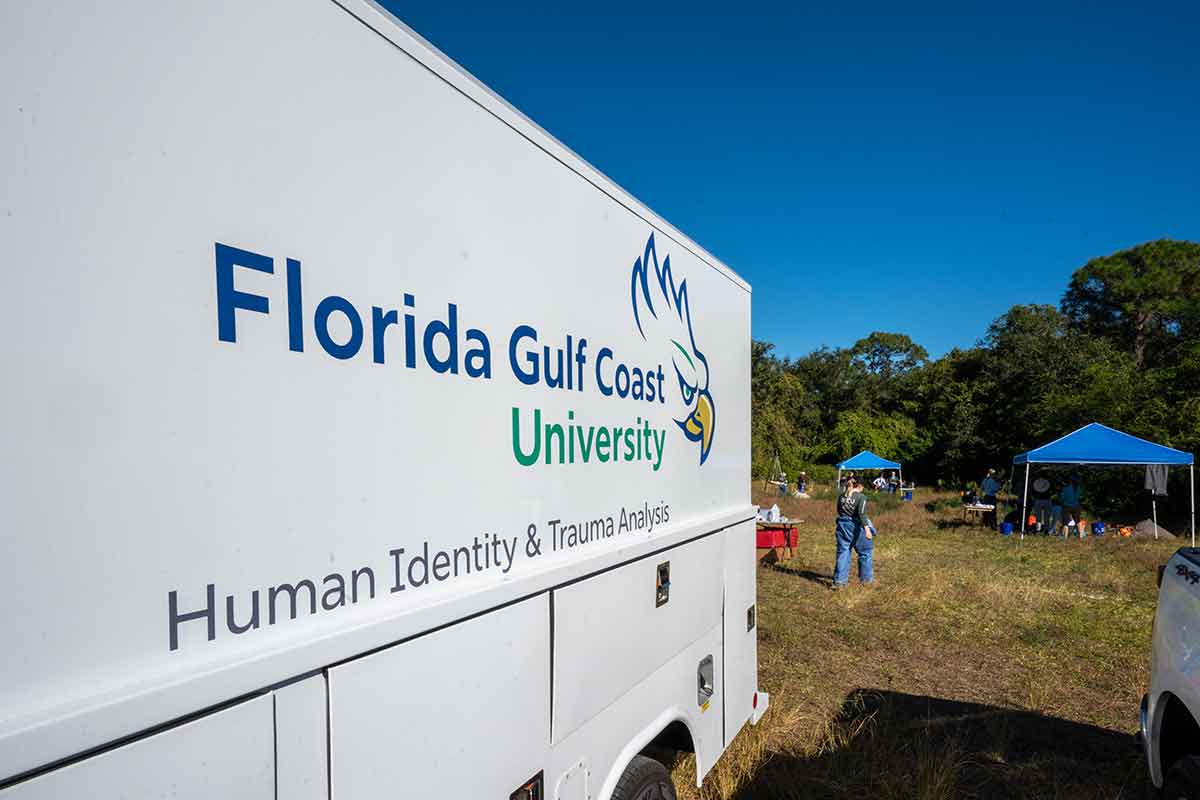
It’s a warm, early morning when more than three dozen students and staff from Florida Gulf Coast University spread out across the Buckingham Environmental Forensics Facility. They’re here to search the “body farm” and sift through layers of sand and plant roots in search of skeletal remains.
With multiple, donated human skeletons strategically buried in various spots at the site in eastern Lee County, teams of students will work throughout the day with student and professional staff from FGCU’s Human Identity & Trauma Analysis Laboratory to uncover the planted “evidence.”
This article includes
images of human skeletal remains used for scientific training.
FGCU's Human Identity & Trauma Analysis Laboratory trains future crime scene investigators, law enforcement personnel, medicolegal death investigators, autopsy technicians, pathologists, forensic analysts and agents, attorneys and paralegal professionals.
Heather Walsh-Haney, FGCU professor, forensics studies program coordinator and chair of the Department of Justice Studies, directs the activity of her staff and students from her forensic anthropology classes. Walsh-Haney, lab manager Micki Besse (’18, master’s in forensics studies, ’25, master’s in clinical mental health counseling) and lab coordinator Savanna Agilar (’18, bachelors in forensics studies and criminal justice; ’22, master’s in forensics studies) will coach them all through the same careful choreography they bring to real crime scenes across Florida and the country.
It’s all part of an experiential program designed to “have them experience deeper learning that they can call upon when they’re out in the real world” of forensics, says Walsh-Haney.
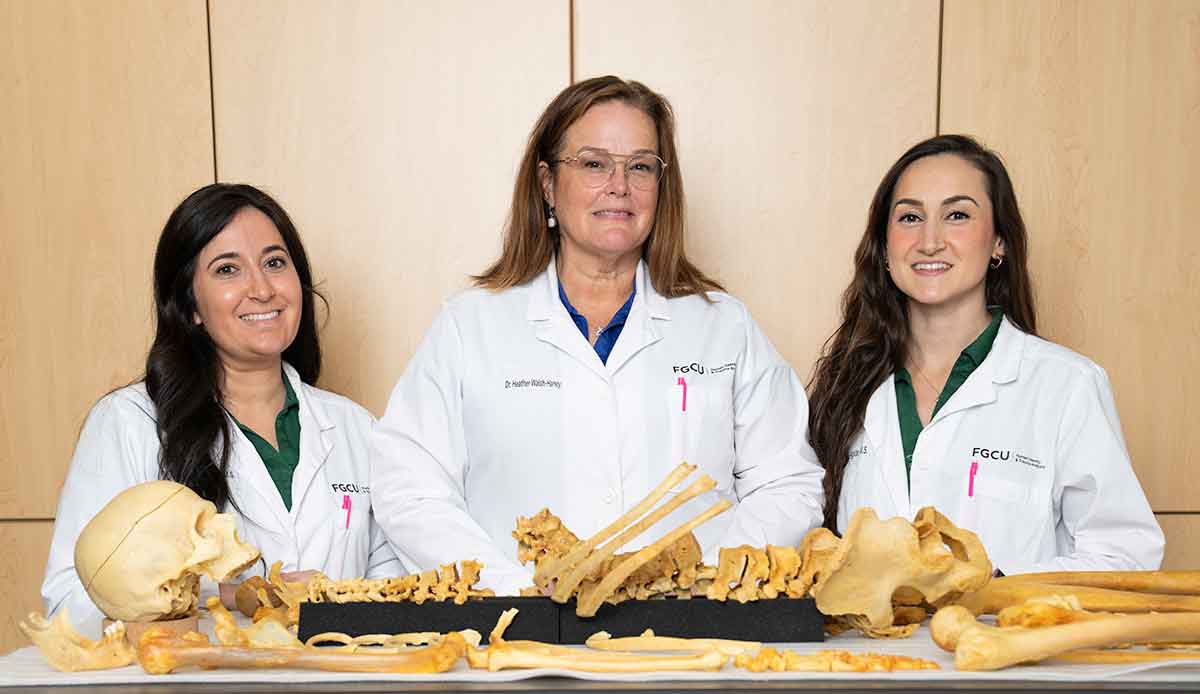
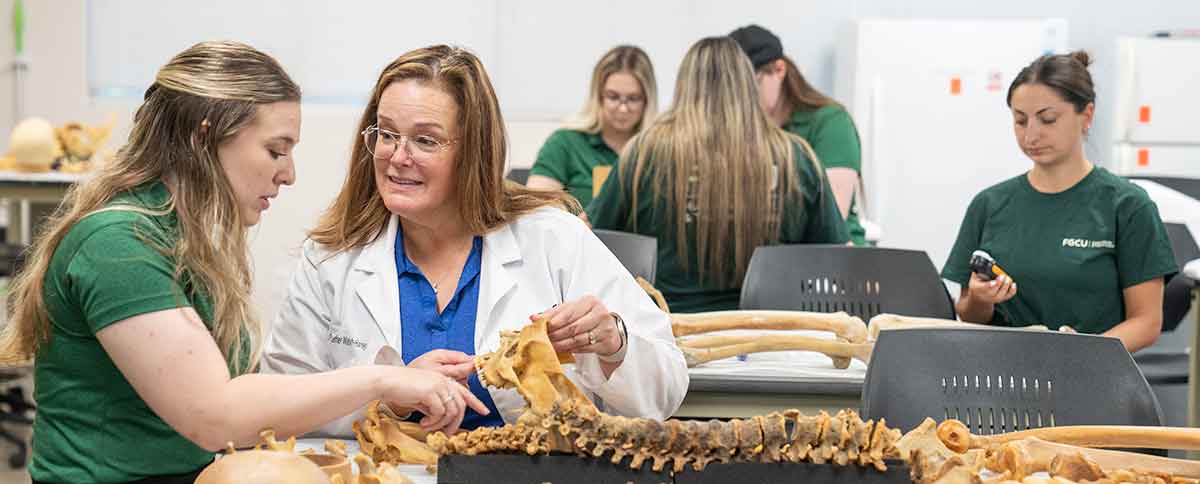
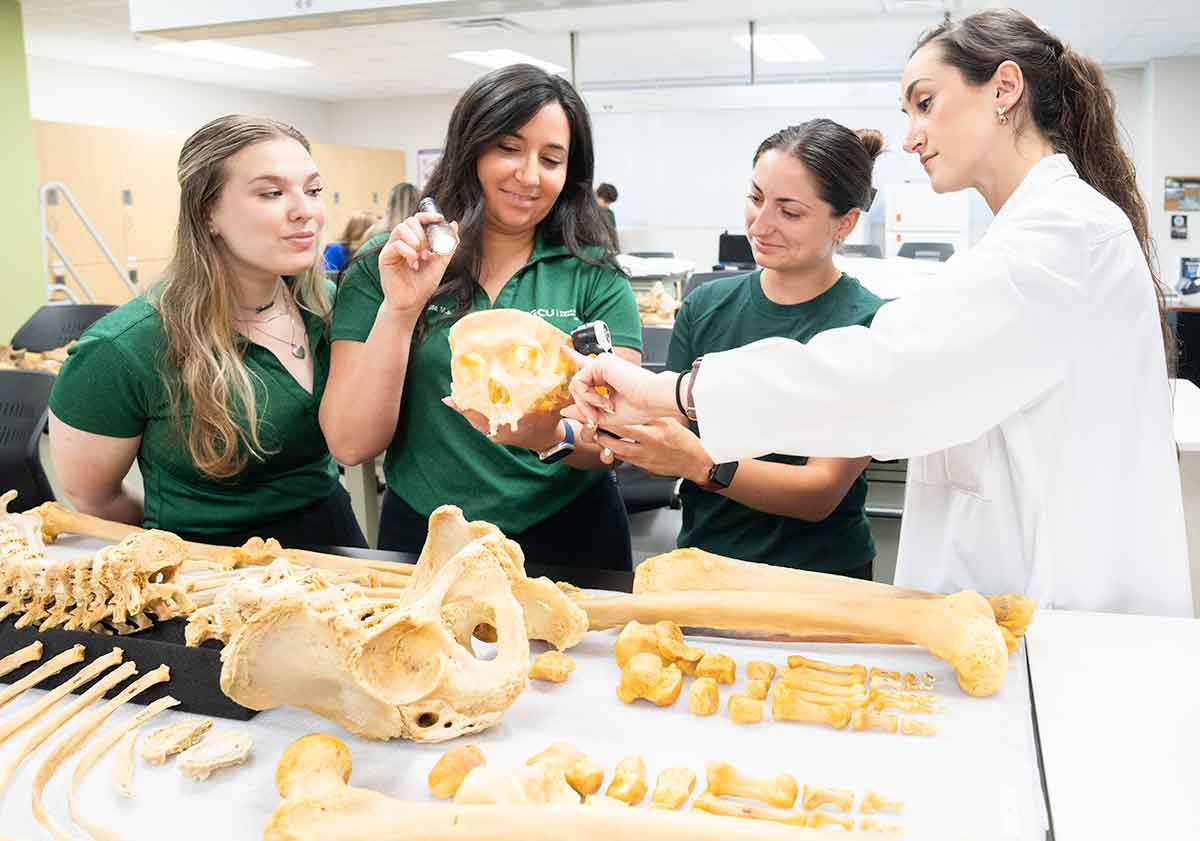
Micki Besse, Heather Walsh-Haney and Savanna Agilar with donated human remains.
From the classroom to the field
The Buckingham Environmental Forensics Facility, situated on part of 500 gated acres FGCU owns, presents a unique simulated crime scene where students apply knowledge and skills they’ve learned in classrooms and labs.
“We’ve modeled real-world scenarios in a controlled environment so that they can see the theory and textbooks come into practice in real time,” Besse says.
As students begin their day at the facility, they put on blue protective “bunny suits” and head out with measuring tapes, compasses, trowels and shovels. A basket of sunscreen containers and tick spray is nearby, along with bottles of water. This is Florida, after all, and Walsh-Haney and Besse emphasize student wellness and safety.
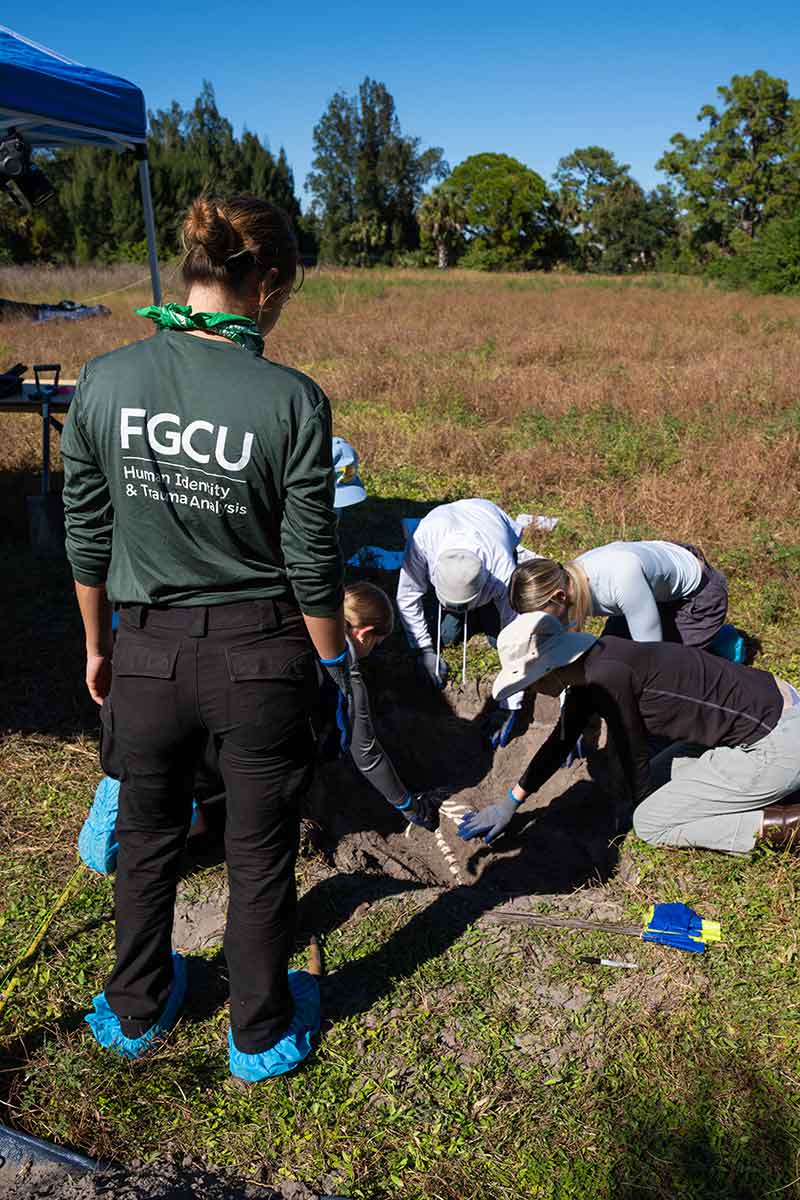
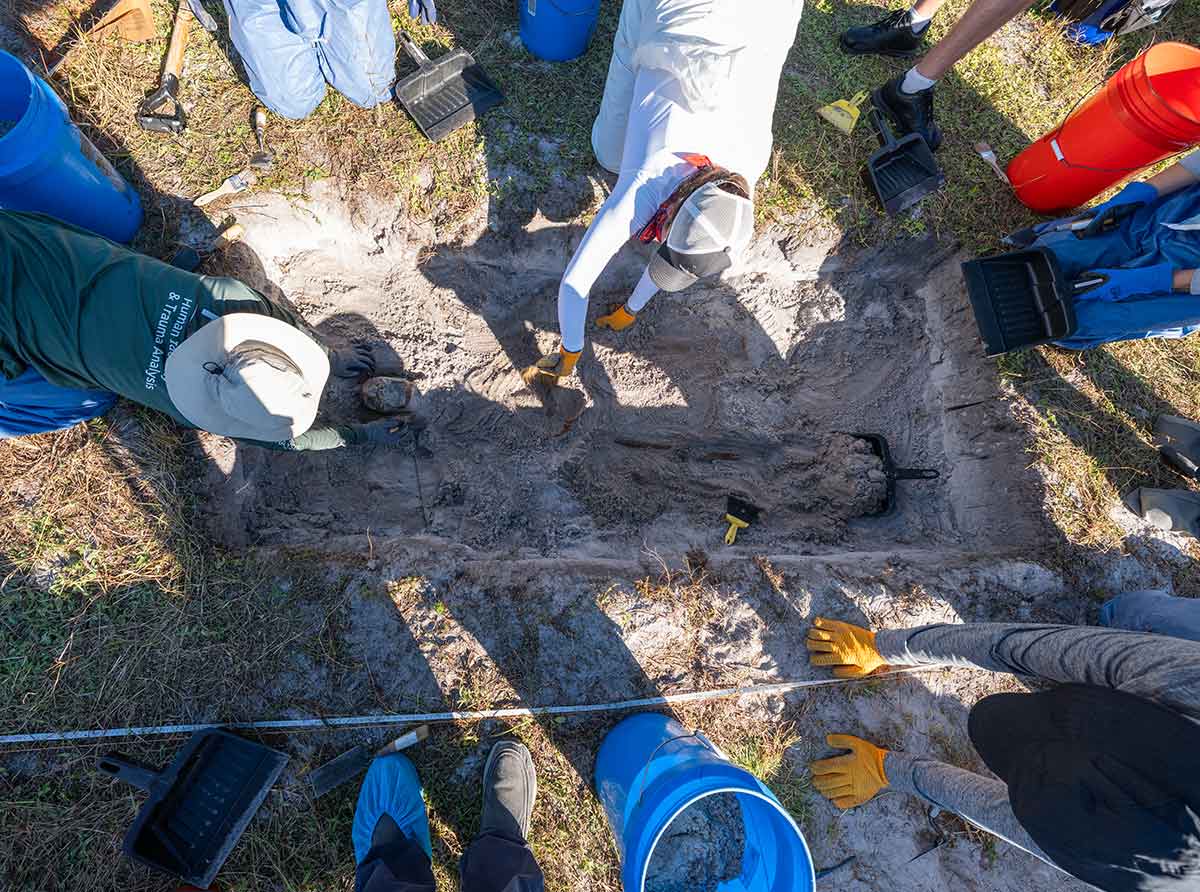
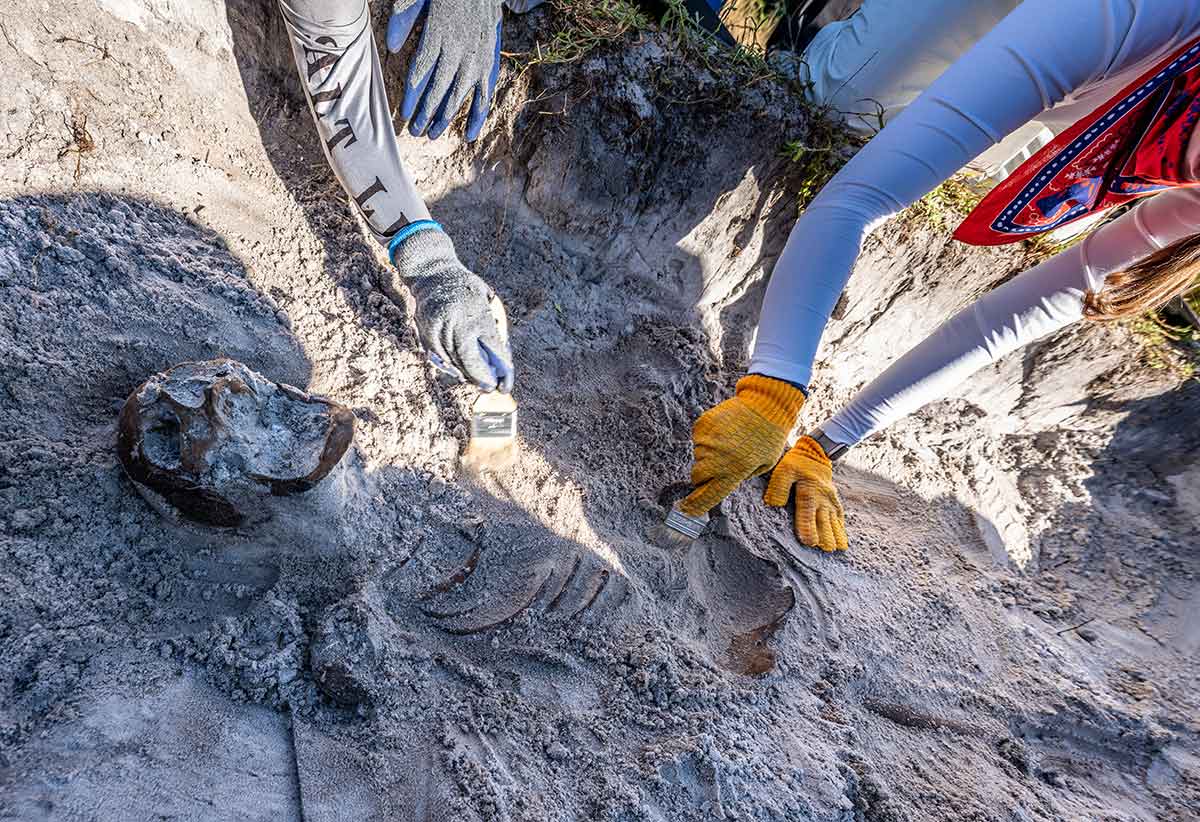
At the Buckingham Environmental Forensics Facility, students unearth human remains.
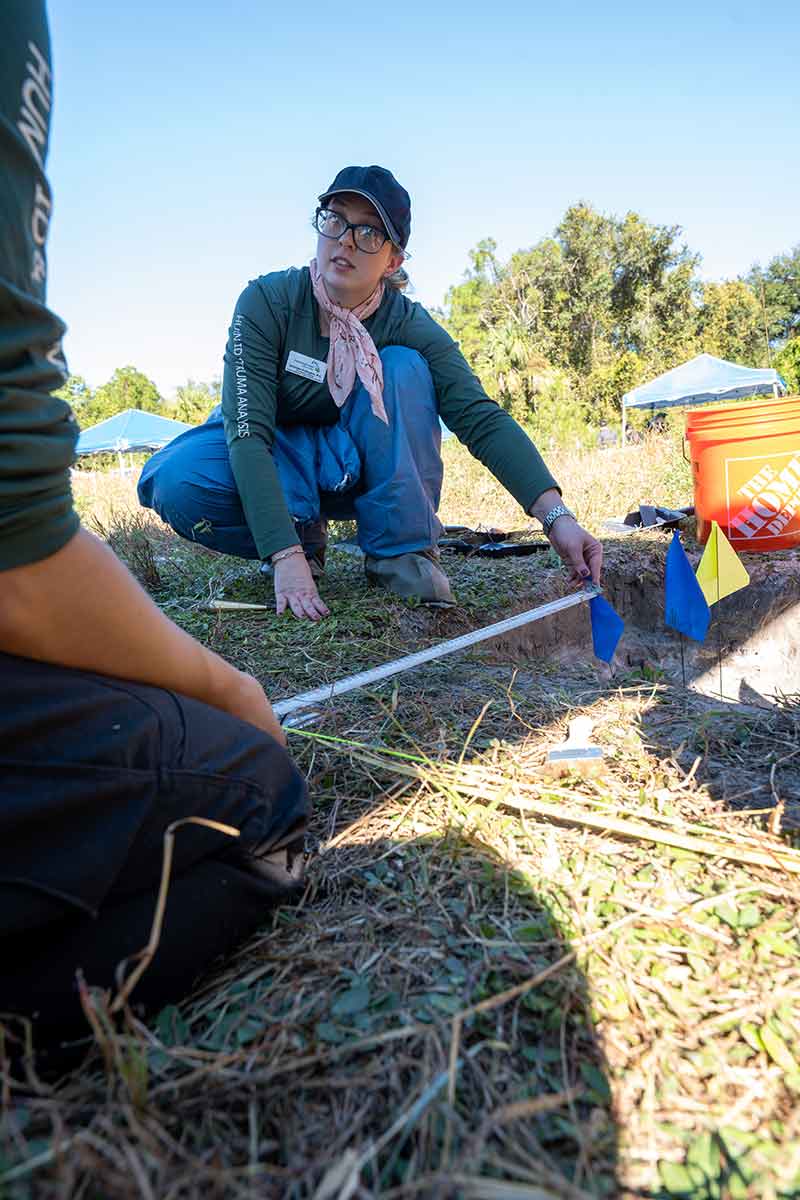
Research assistant Emmalee Bullington works with students in Walsh-Haney's forensic anthropology class.
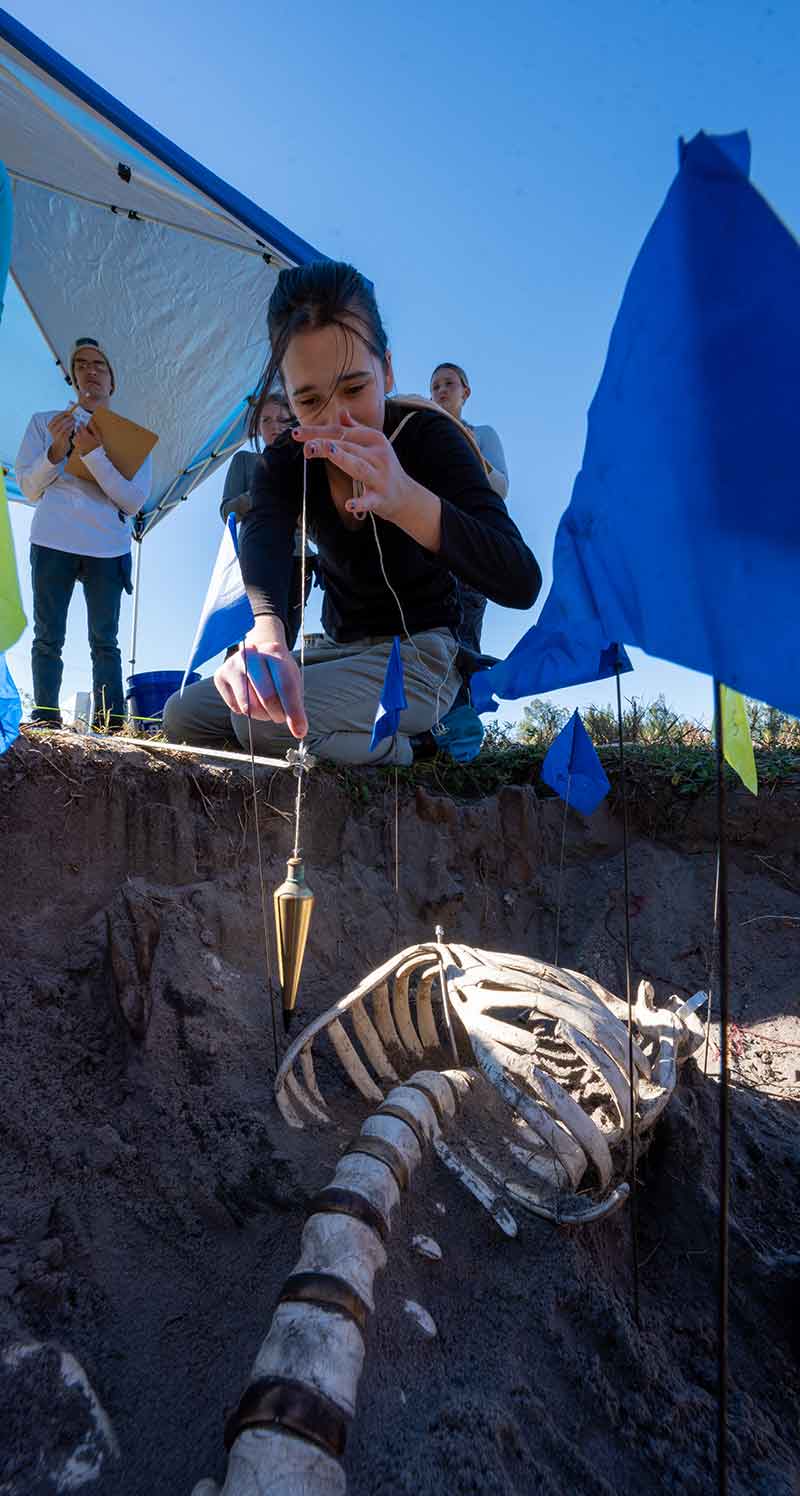
Michelle Gordon uses a plumb bob to measure depth in an excavated unit.
The fenced‑in area where they work stretches out in a patchwork of sandy clearings that mark grave sites, cabbage palms and tangles of scrub oak. Students make their way in small groups to their assigned grids.
One team establishes a scientific baseline by digging a one‑meter square shovel test pit on their plot. They measure and record soil temperature, pH and moisture as their environmental “control.” Another group walks the scene the way investigators do, scanning for safety hazards and noting any additional evidence in the area, including animal remains that might initially appear suspicious.
Part-time research assistant Mariah Zarria (’25, forensics studies) orients north, south, east and west with her group using a compass and handheld GPS. To build redundancy into their documentation, they back up digital measurements with old‑school methods such as establishing fixed reference points and traditional compass-and-distance techniques. They trim vegetation to the burial surface, lay a baseline along north-south and start digging or excavating to expose underlying soil discoloration that may mark the outline of a donor skeleton.
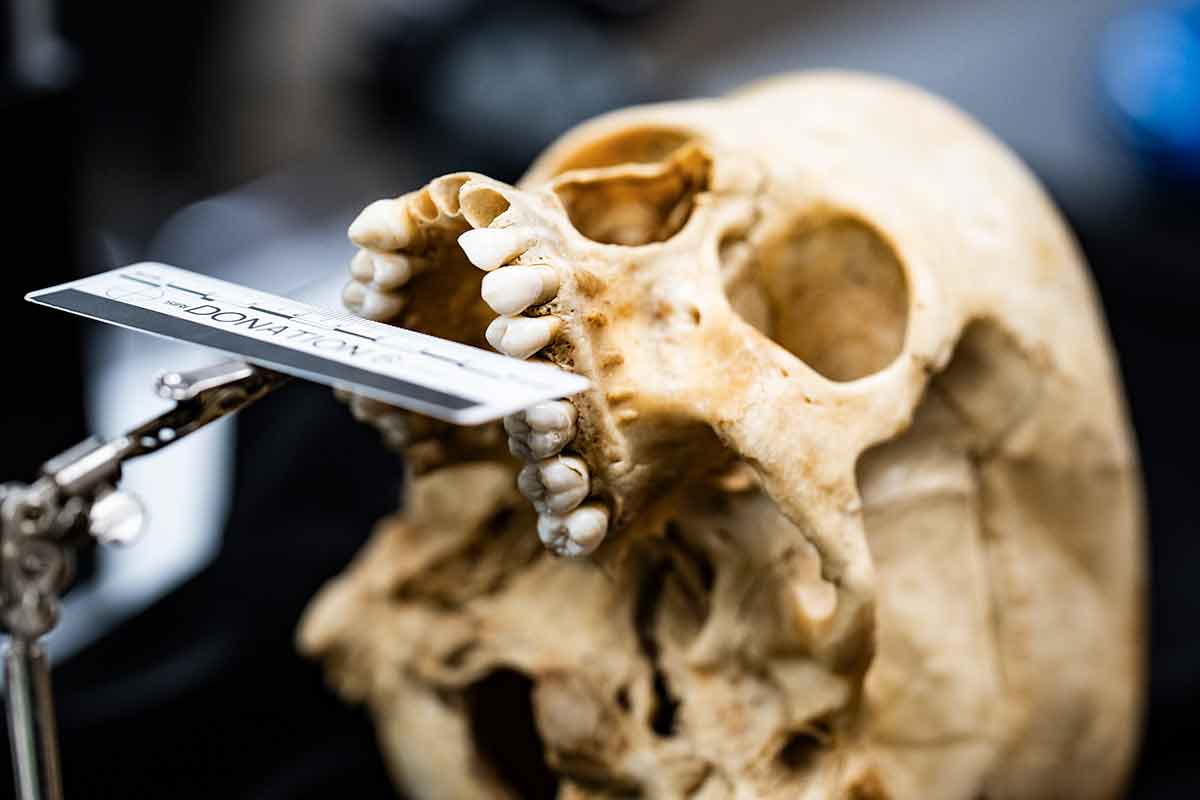
FGCU’s Human Identity & Trauma Analysis Laboratory includes human remains generously donated by families to help advance scientific research.
“When someone calls out a measurement, we’re going to repeat it loudly and proudly,” Zarria says as the students work together to measure the grave wall. Some kneel on the ground, moving soil with trowels, while some stand by taking notes. After a while, they switch roles so everyone has an opportunity to experience the various jobs on a scene.
When they uncover human remains, students are trained to handle them sensitively. Not merely simulated evidence, the skeletons are donations for science that allow students a unique, experiential learning opportunity. The generosity of private donors helps Walsh-Haney impart “a legacy of compassion, ethics, transparency and seriousness” to her students.
At an actual crime scene, she says, “We know families are watching — news media gets on the site immediately — because they have sons and daughters missing.
“I want my students to be able to run a scene like that,” says Walsh-Haney.
Walsh-Haney instructs students in the Human Identity & Trauma Analysis Laboratory at FGCU's Emergent Technologies Institute.
Engaging students in active field work
In 21 years at FGCU, Walsh-Haney has taught and collaborated with countless students. But she’s quick to trace the legacy of mentorship back to one of her own professors at the University of Florida: William R. Maples, the prominent forensic anthropologist and author of “Dead Men Do Tell Tales,” a seminal, pioneering book credited with popularizing forensic anthropology.
In 1996, Maples worked with medical examiners to identify fragmented remains of passengers killed when ValuJet flight 592 crashed in the Everglades. He and his team of students — including an undergraduate Walsh-Haney — helped identify 11 child victims.
Now, she is one of fewer than 125 active forensic anthropologists certified by the American Board of Forensic Anthropology, according to its website. She estimates she has consulted for law enforcement and medical examiners on more than 2,000 cases while at FGCU and works around 100 field cases with approximately 15 field recoveries annually. She brings students who have passed competencies and level two background checks along as often as possible.
“Other programs may consider undergraduate involvement an Achilles’ heel, but I’ve continued Maples’ tradition of using undergrads. You don’t get that opportunity everywhere,” Walsh-Haney says.
The day after the Buckingham field exercise, she took two students to Broward County to investigate a plane crash. The following week, Walsh-Haney took her research lab coordinator, Agilar, to Oklahoma where she has been involved for the past four years in excavating the site of the 1921 Tulsa race massacre.
“Our program at FGCU is unique because we are doing active casework — and I bring those experiences into the classroom and with students coming to court to watch me testify as well,” says Walsh-Haney.
Ashley Paris, Micki Besse, Azaria Barkeloo and Savanna Agilar.
“Up against a clock”
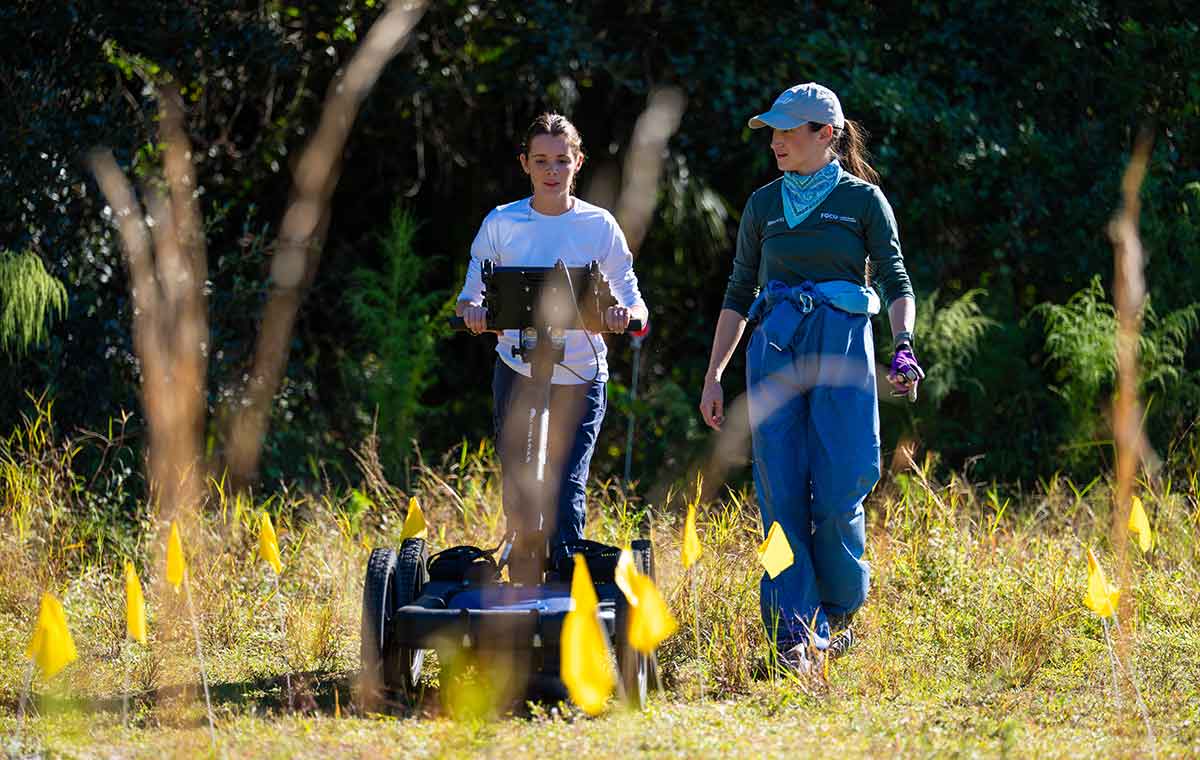
As the day progresses at the Buckingham facility, environmental studies major Kaity Eubanks is assigned to operate ground-penetrating radar equipment. Over the last six months, she has advanced from Walsh-Haney’s student to lab intern.
“I’m an undergrad, I’m 20 years old and I’ve already had so much experience that I can share with potential employers,” Eubanks says.
Kaity Eubanks operates ground-penetrating radar equipment under the supervision of lab coordinator Savanna Agilar.
Students brush dirt from skeletal remains in a simulated shallow grave at the Buckingham Environmental Forensics Facility.
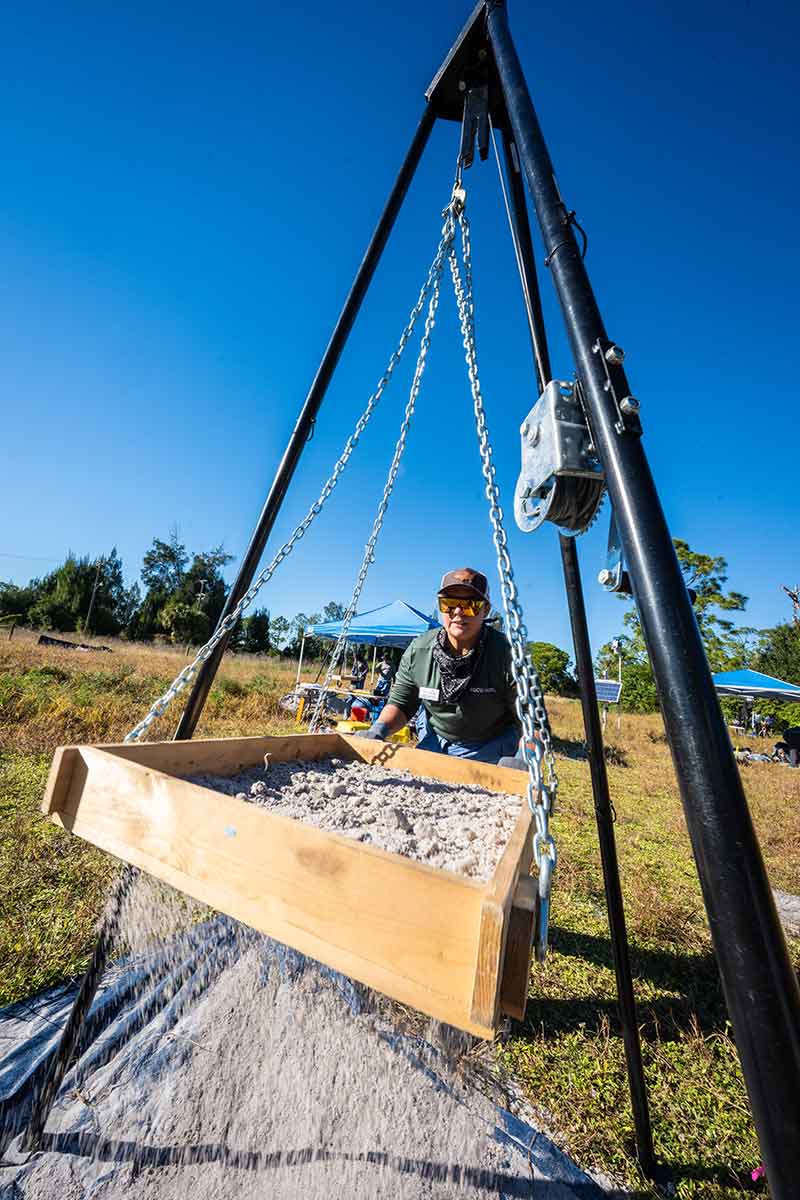
Gracie Hinton works a tripod soil sifter.
Around
noon, Agilar and research assistant Paige Roberts, a forensics studies major
who plans to continue with her master’s at FGCU, coach their group of students
through classic field techniques. They demonstrate how to use a plumb bob — a
weight attached to a cord — to measure depth in an excavated unit. Graduate student
teaching assistant Claudia Marquez is working a tripod soil sifter when
Walsh-Haney stops to check on her group.
“We
found a phalange. Pretty sure it’s a distal phalange, tip of the thumb maybe?”
Marquez says. The group smiles at each other when Walsh-Haney confirms their
finding.
The sun
is a bit lower in the sky as grad student Abigail Paul tells her group, “This
is the time of day when cops are staring at you, saying, ‘Let’s go.’”
“We’re
always up against a clock,” agrees Walsh-Haney.
Usually,
a forensic consultant is the last professional called to a crime scene.
Anything the team digs up on a case would then go to the medical examiner’s
office. But today’s “evidence” — donor remains — has to go back where it was
found, to benefit the next group of students.
Even as
the day ends, its impact stretches far beyond the Buckingham property’s fence
line.
“The
experiential learning that happens at FGCU is keeping the pipeline [for
forensics experts] going in the five Southwest Florida counties. This brings
the FGCU footprint all over Florida,” says Walsh-Haney. “At the end of the day,
we’re serving the state of Florida. The work helps the living and the dead.”