Florida’s recent history is often told through stories of tourism booms, space exploration, the citrus industry and rapid population growth. But one class at Florida Gulf Coast University encourages students to look beyond headlines at the many other forces that have shaped the Sunshine State’s identity.
“The great thing about Florida history is there are so many topics,” Lipsey says. “The class gives students space to learn more about their interests.” It also gives them hands-on experience using primary and secondary sources such as those housed in FGCU’s University Archives & Special Collections.
“I refer to all my students as historians for the semester. We read, we write and we talk. It’s OK if their interpretation doesn’t match others,” Lipsey says.
Her course asks students to dive deeper into Florida’s history and analyze how it has been constructed and interpreted.
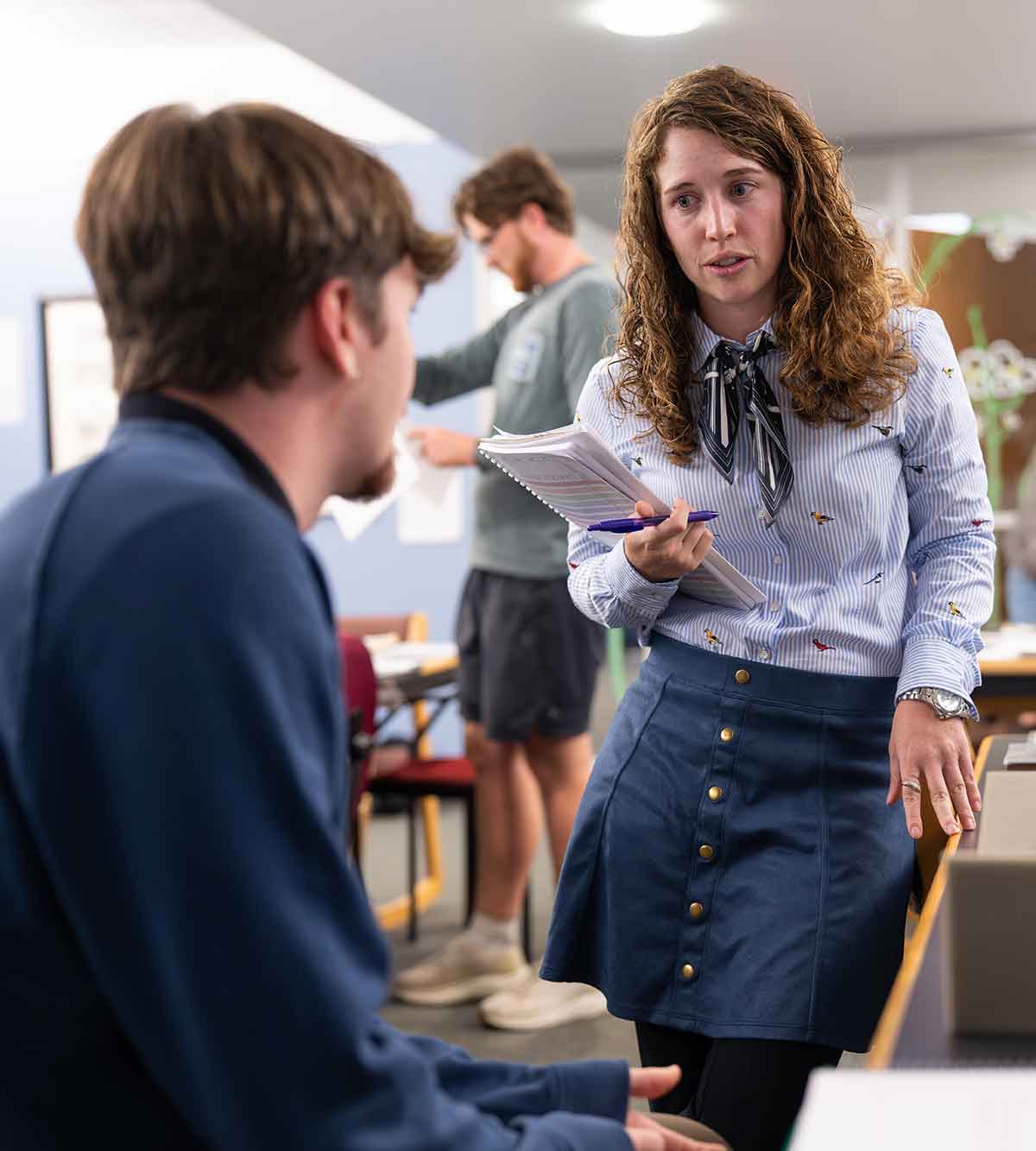
Hanna Lipsey talks to a student on Library Day in the University Archives & Special Collections.
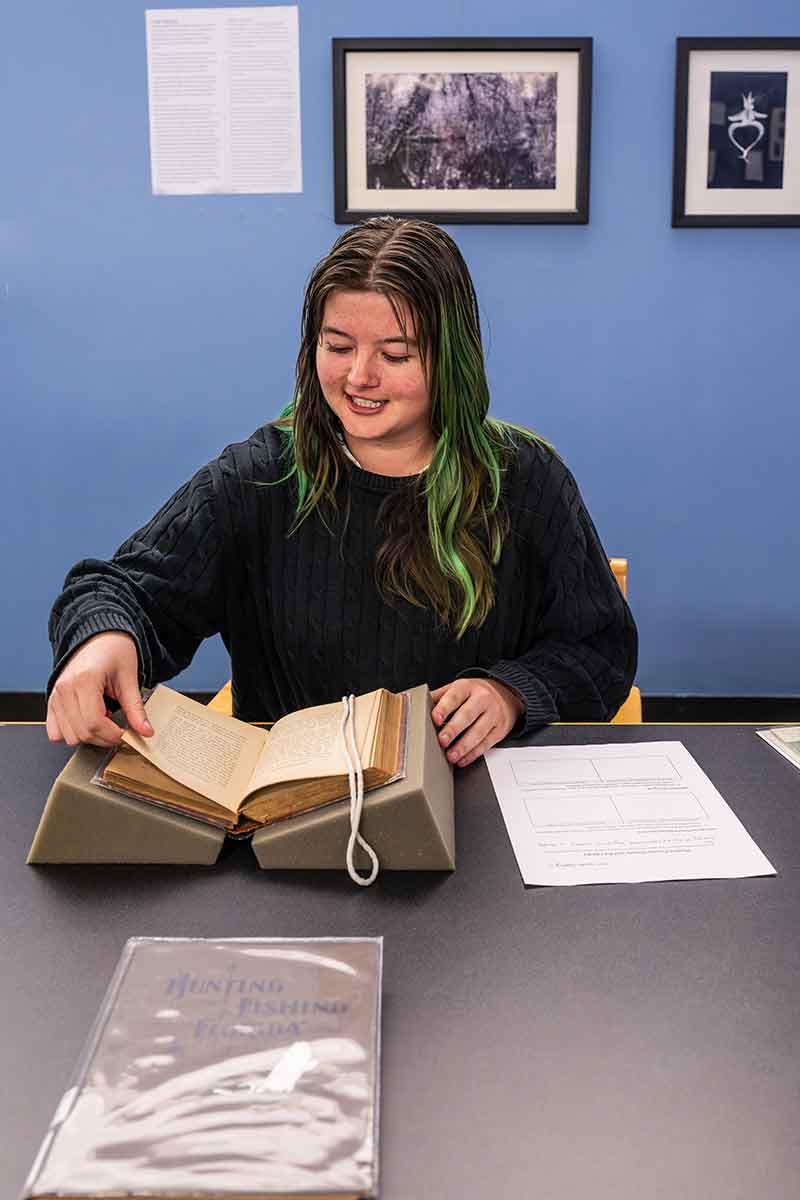
Sarah Shelley is interested in how Florida's over-65 population is growing faster than other age demographics.
Migration to The Sunshine State
As an environmental studies major, senior Sarah Shelley is exploring why retirees move to Florida, what role the environment plays in their decision-making and how this migration affects their health and well-being. Her work in Lipsey’s class complements that research.
“Research is a much deeper and fulfilling experience when you’re looking to understand the full scope of a topic,” the Honors College student says. She’s studying migration patterns to Florida with a focus on the “graying” of Florida — how the over-65 population is growing faster than other age demographics.
“Snowbirds have a really long history in Florida. There have been different reasons people come to Florida,” Lipsey says.
Passionate about history
When Lipsey’s lecture reaches the early 20th century boom years and the dawn of Florida’s racing history, Shelley perks up. A lifelong motorsports fan who sports a NASCAR tattoo, she says the in-class discussion helped her see how cultural identity, politics and class tensions played out on Florida’s Atlantic Ocean beaches, where races were originally held, long before the advent of today’s super-speedways.
“I loved the implementation of racing history,” Shelley says. “Cars, especially in the American South, represent a great deal more than just going fast. They represent defiance, freedom and anti‑authoritarianism,” she says, pointing to the moonshiners of Prohibition and Ormond Beach car races as being the roots of NASCAR.
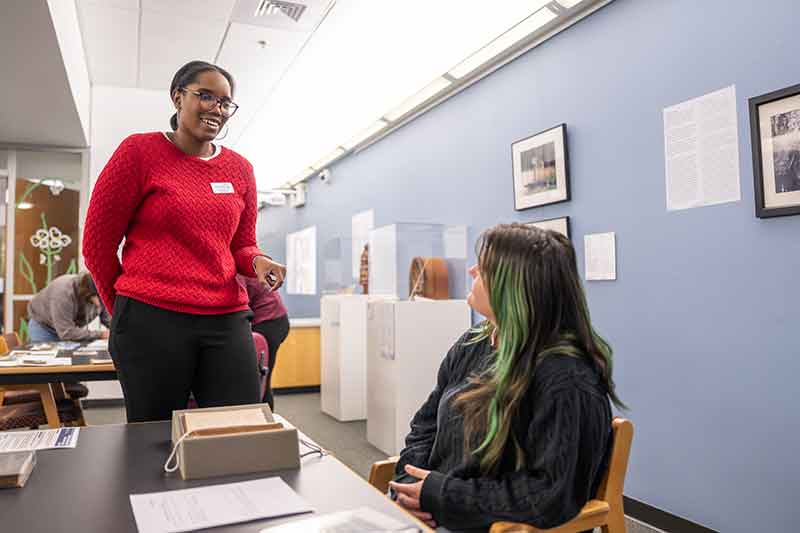
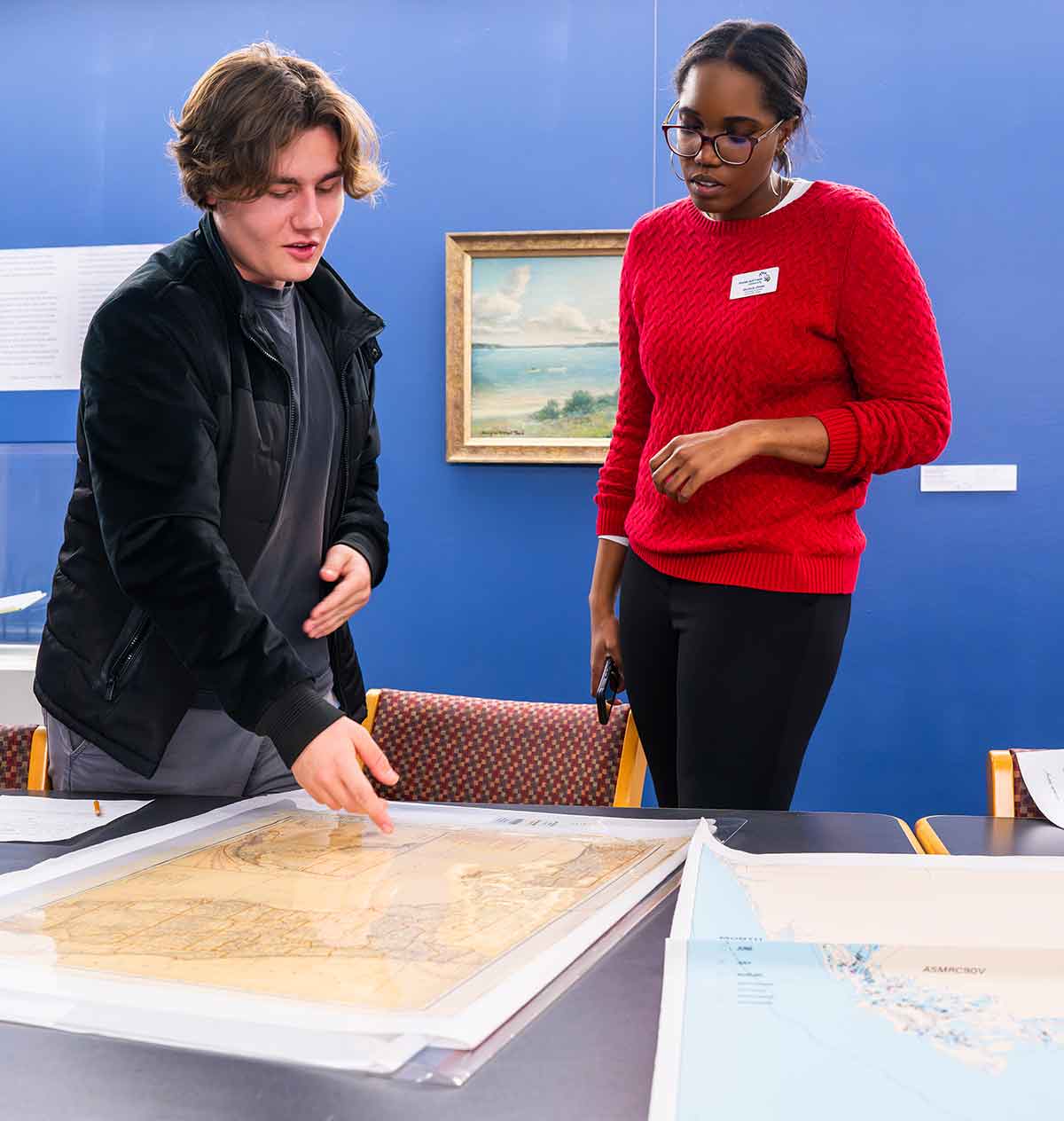
Archivist Victoria Jones talks to Sarah Shelley about her interest in the graying of Florida.
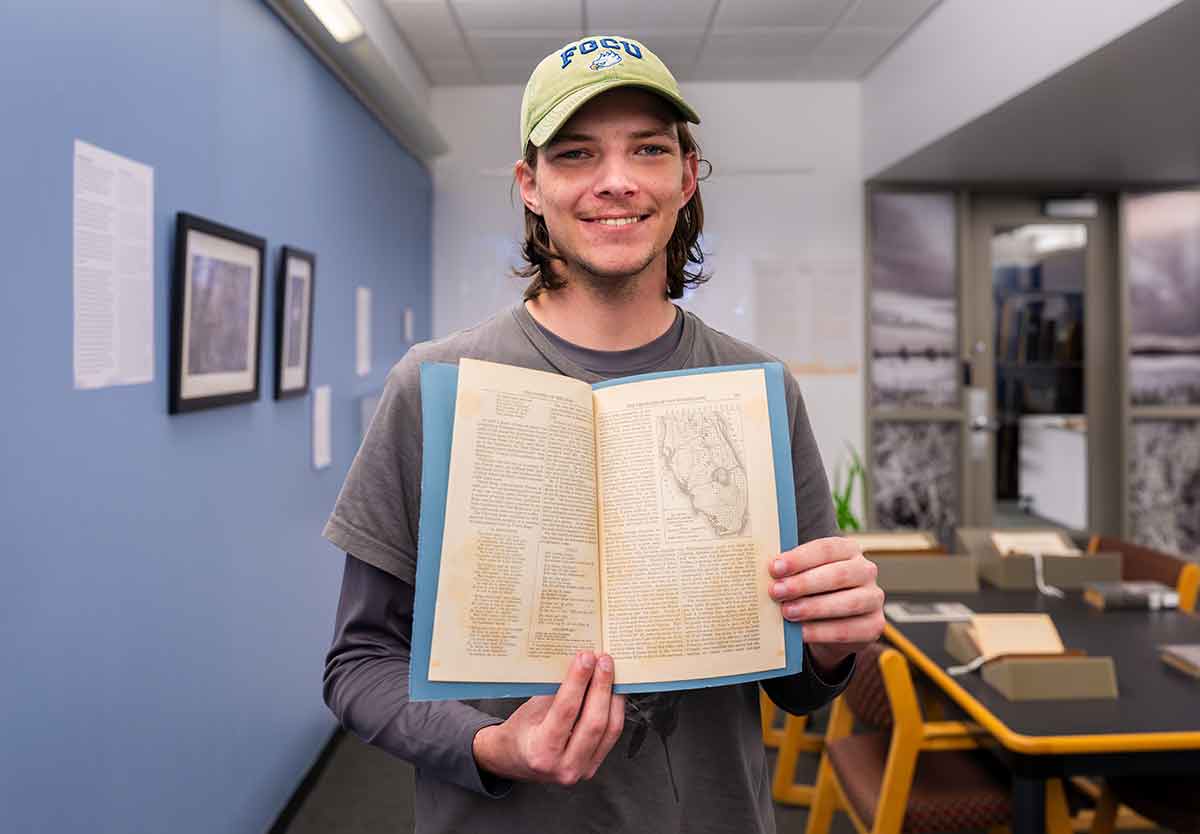
Harrison Pastuszek holds up a slim volume containing a reprint from Harper's New Monthly Magazine, “The Drainage of the Everglades,” 1883. Florida Gulf Coast University Archives & Special Collections. Floridiana.
As the class discussion moves into the modern era, Lipsey’s students transition from reading and talking about history to seeing primary documents — with a field trip to FGCU’s Wilson G. Bradshaw Library. Guided by library faculty, students learn to navigate archival materials, evaluate sources and begin shaping research topics that will carry through the rest of the semester.
“The students ask good and supportive questions of each other. They let each other show off their knowledge, which was magical,” says Lipsey.
Using University Archives & Special Collections, previous students in Lipsey’s history classes have developed projects rooted in original research and personal interest. One history major explored the legacy of the traveling landscape painters known as the Highwaymen, while a psychology major examined the history of the Florida Fish and Wildlife Conservation Commission — a potential career path for the student.
The point, Lipsey says, is “to do as historians do and do a deep dive on a subject they’re passionate about.”
Digging into the University Archives & Special Collections
Alexandria, Virgina, native Harrison Pastuszek is a political science major who decided to write his class project about early attempts to drain the Florida Everglades. During the class’s visit to the archives, he found a useful source in a slim volume containing a reprint of an 1883 magazine article titled “The Drainage of the Everglades.”
“It describes the first attempts to dig canals and the processes used to drain parts of the Everglades to be used for agricultural purposes,” says Pastuszek. “Using primary and physical sources builds a more personal connection to the topic I’m researching.”
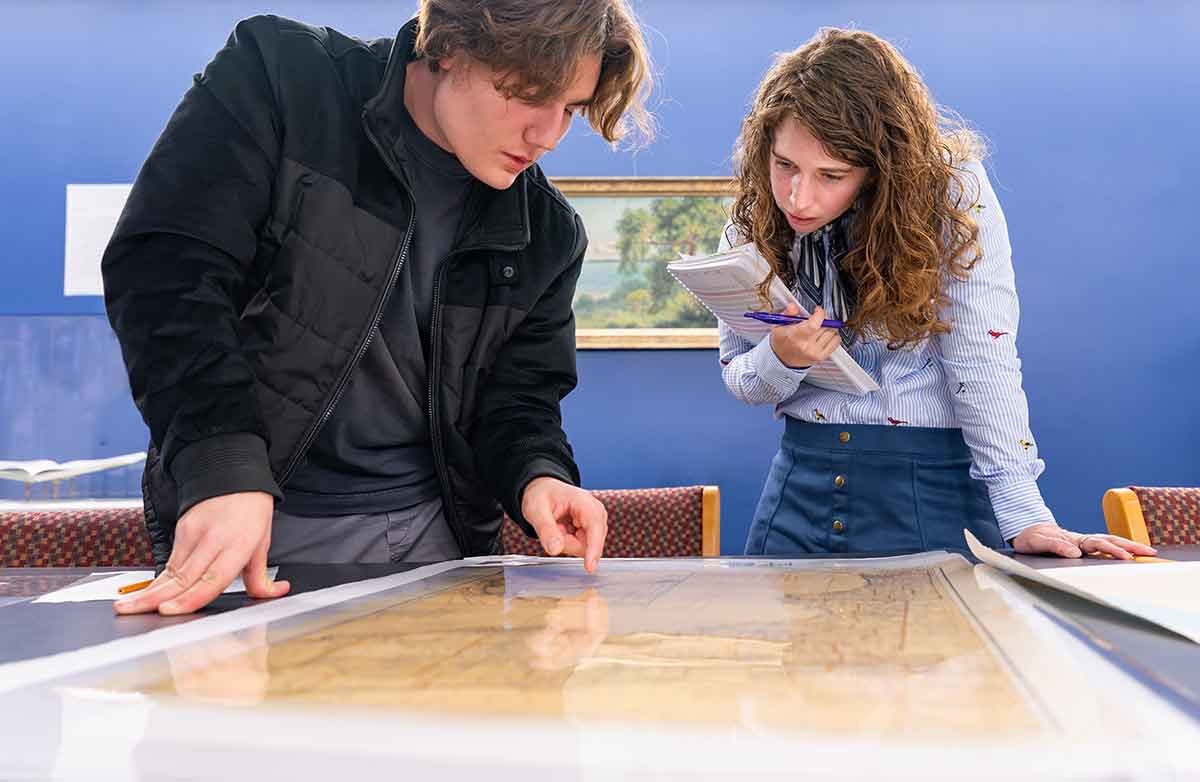
Ryan Masterson and Hanna Lipsey look at a 1920 Florida railroad map together on Library Day.
Masterson talks to archivist Victoria Jones about his interest in Florida railroads.
Meanwhile, his classmate Ryan Masterson pored over a 1920 Florida railroad map. The Naples native, a history major and Honors College student, noted that his hometown didn’t have a rail route at the time.
“Getting to see all the different railroads that I’m familiar with and where they were located at the time was very interesting,” he says. “It made me think about how fast towns grew when the railroad came in. The railroad in Florida is the main reason the state is as developed as it is today.”
He plans to focus his paper on the Florida East Coast Railway, which connected Jacksonville to the Keys.
In a state often defined by speed — development, growth, reinvention — Lipsey’s classroom asks students to pause and examine how Florida became what it is today. By grounding their work in archival materials and original analysis, students learn historical dates and facts as well as how narratives are formed, challenged and revised. In the process, they come to see Florida not as a finished story but as one still being written — and one they now have the tools to question, interpret and understand.
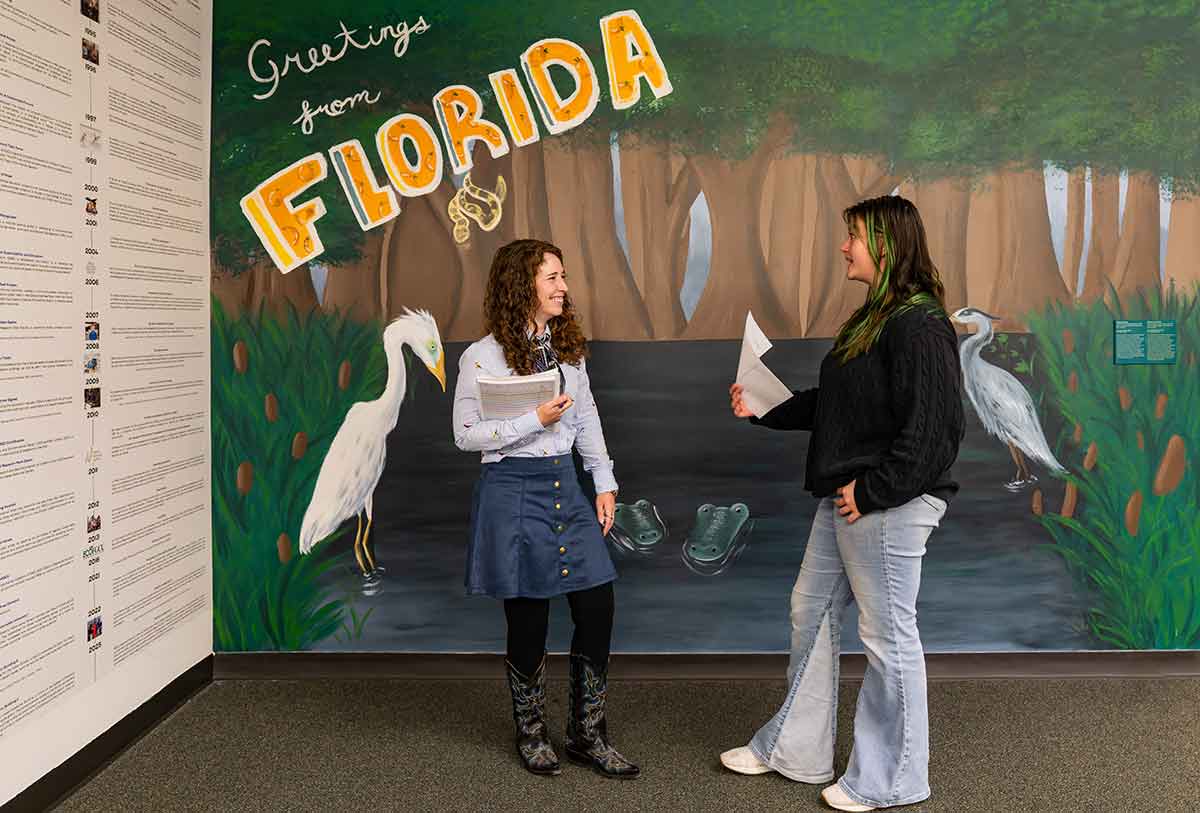
Hanna Lipsey and Sarah Shelley stand in front of a mural that is part of the current exhibition on “Nature” at the University Archives & Special Collections.