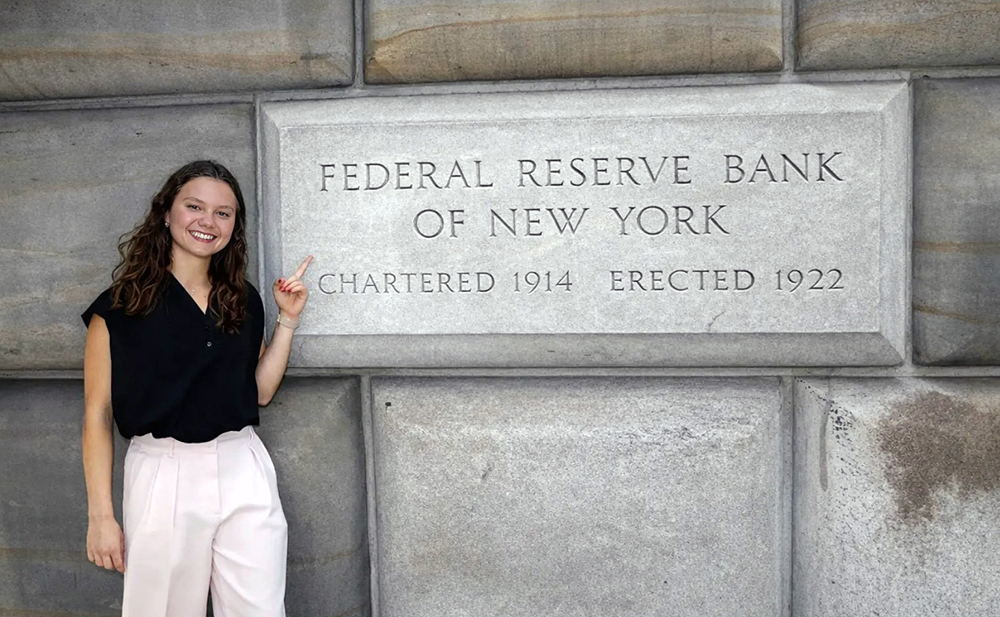
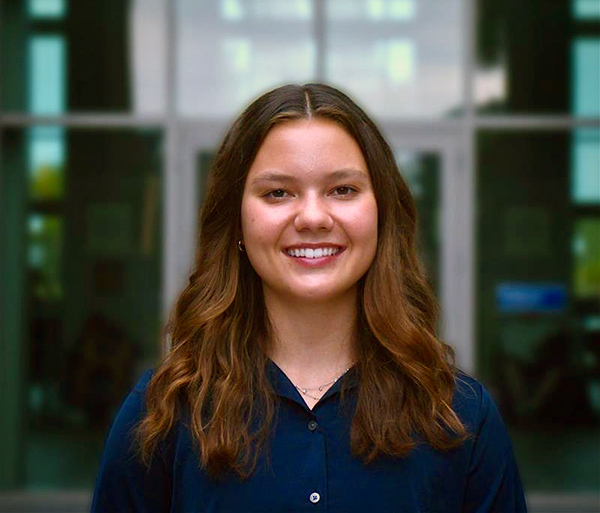
Ashley Fearday couldn’t believe she was selected from a pool of roughly 16,000 applicants for an internship with the Federal Reserve Bank of New York in summer 2025.
This opportunity was a turning point that affirmed the strength of her preparation and set the stage for a transformative professional experience.
Although she was uncertain about how she would stack up with the Ivy Leaguers there, she was selected as one of the top interns to present her project to the bank’s executive office.
Although positioned to return for another internship this summer, she was confident enough in her trajectory to pivot. She accepted an offer from JPMorgan Private Bank so she could gain exposure to the private sector of finance.
“Applying to an institution like the Federal Reserve Bank of New York felt intimidating, but I viewed that discomfort as a signal that the opportunity could lead to personal growth," Ashley Fearday said. Photos submitted.
“This (Fed) internship was not just a summer opportunity, but proof of how FGCU prepares its students to compete at the highest level,” says Fearday, a junior with a double major in finance and economics and an Honors College student.
“FGCU provided the academic foundation, mentorship and confidence that allowed me to pursue and succeed in spaces I once thought were out of reach. I hope my experience encourages other students to believe in their potential, take advantage of FGCU’s resources and pursue ambitious opportunities with confidence.”
“Internships are an extremely popular experience among FGCU students, and one that many of them are eager and excited to seek out,” Droz says. “At FGCU, we take a proactive and comprehensive approach to connecting students with internships and other work-based learning opportunities.”
That includes centralized tools such as Eagle Career Network, which employers use to advertise internship positions; a network of internship coordinators and faculty providing one-on-one coaching; partnerships with employers and on-campus departments such as Career Development Services; internship-focused programming and events such as the All Majors Career & Internship Fair happening Feb. 26; and course-based internships embedded in the curriculum.
Furthermore, Droz and her staff work closely with faculty and advisors to ensure students are aware of opportunities early and understand how internships fit into their academic and career goals.
Fearday says she sought an internship because she wanted to move beyond theory and understand how economic and financial concepts operate firsthand. Her coursework and experience conducting economic research for FGCU’s Regional Economic Research Institute provided her with a strong analytical foundation, but she was curious about how these concepts impact society on a larger scale. What better place to learn about the economy and monetary policy than the Federal Reserve?
“I was also motivated by a desire to challenge myself,” she says. “Applying to an institution like the Federal Reserve Bank of New York felt intimidating, but I viewed that discomfort as a signal that the opportunity could lead to personal growth. I wanted to test my skills, resilience and confidence on a national stage.
“I also understand that internships play a critical role in career exploration,” Fearday says. “They are vital to differentiate myself and prepare for the competitive job market I will be transitioning into post-graduation. I want a variety of internship experiences and exposure to different paths within finance and economics to make more informed decisions about my long-term career goals. This internship allowed me to explore risk management, public service and economic policy-oriented work in a way that no classroom alone could replicate.”
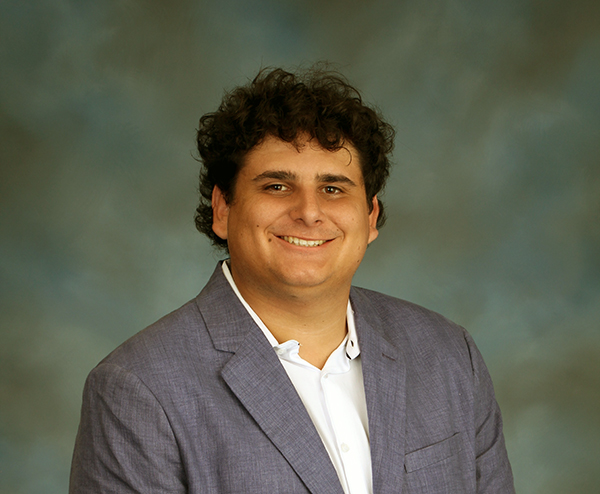
Boaz Ginns
It also positioned her to meet people she never expected to meet. One day, a fellow intern texted her saying, “You’ll never believe who just sat down to eat lunch with us.” When Fearday joined them, she found John Williams, president of the New York Fed, casually eating pizza with a group of interns.
“While he did not share any insider information about future interest-rate decisions, the experience perfectly captured the Fed’s culture — approachable leadership, open dialogue and a genuine commitment to learning,” she says.
Learning to adapt in the field
Like Fearday, Boaz Ginns believes real-world experience is integral for learning.
“The concepts, ideas and content that are delivered in the classroom are very important, but a classroom is a controlled environment,” he says. “In the field, there are variables that may not be controllable. Real-world experience allows you to learn to adapt to new ways, methods and ideas in order to continue the mission.”
A senior with a double major in criminal justice and forensic studies, Ginns recently finished a six-month internship with the Department of Homeland Security. He worked with federal investigators using data and technology to understand crime patterns.
Working alongside a variety of agents rather than one person or task force allowed him to be involved in different types of investigations. He engaged in open-source intelligence gathering, learned how to forensically analyze and disassemble a computer, participated in a federal search warrant and observed agents working in the field.
“In the classroom, I do the work to learn the material and get a grade. In the field, the work I do helps promote justice and make victims whole. That sense of purpose continues to drive me to do well academically and in the world,” he says.