Claude Villiers doesn’t believe learning should stop when students walk out the lab door. In his Civil Engineering Materials course, that means trading a traditional concrete lab for something more ambitious: hands-on projects designed for real-world testing at the American Society of Civil Engineers (ASCE) competition March 12-14.
Three teams of Florida Gulf Coast University civil engineering majors have taken Villiers up on the challenge. The competition requires students to design and fabricate items or structures such as a canoe, doghouse or cornhole game using concrete.
“All of [the projects] have a set of regulations they have to follow in terms of size, construction, what they can put on it, what they cannot put on it. Then they leave it up to you to use your engineering ability and critical thinking to execute and win the competition,” said the U.A. Whitaker College of Engineering professor known to students simply as “Dr. V.”
Claude Villiers’ civil engineering students conduct laboratory experiments to design concrete mixes for infrastructure use.
The challenges of using concrete
Creating these concrete items might seem simple, but there are unique challenges with each one. Concrete is a mix of materials — including coarse and fine recycled aggregates, admixture and cement — and paste (tap water acting as a glue to provide strength). It’s notoriously weak in tension (pulling or stretching forces) but very strong in compression (squeezing forces), so students must really think through their designs.
For example, a concrete cornhole board needs to withstand being repeatedly hit by bean bags thrown from a distance. Without the right mix, the board can crack. That’s the challenge taken on by Adam Blais, Hunter Hart, Jackson Allaire and William Kalvin. Kalvin compared creating the concrete mix to baking: “It’s like putting cake batter into a pan that you have to put into the oven, but our oven is a big tub of water that lets the concrete cure so that it remains strong and flexible.”
William Kalvin, Jackson Allaire, Adam Blais and Hunter Hart are working on a concrete cornhole board.
Ariela Galvan and Adrian Boguslaw have teamed up to design concrete golf balls.
They’ve faced a few challenges so far, including figuring out how to create the six-inch hole in the form. Adam explained how they first looked at piping but found that most pipes have an outside diameter that was beyond their allowed tolerance.
“We chose to cut little circles out of the plywood and screw them all down,” he said.
Meanwhile, Adrian Boguslaw and Ariela Galvan have teamed up to design concrete golf balls that can be played. The pair created a silicone mold shaped like a regulation golf ball, then began experimenting with concrete mixes made from water, cement and aggregate. Once poured, each ball must cure for 28 days before testing begins. From there, it’s a cycle of trial, failure and refinement as they adjust the mix to improve performance.
Their biggest challenge comes down to water.
“If we add more water, it’s going to fit into the mold more easily and be a better shape, but if we add too much water, it’s not going to be strong enough when we play with it, and it’s going to break,” Boguslaw said. “That’s the biggest challenge of our competition — doing a lot of testing with the concrete and trying to find the perfect mix for the golf ball.”
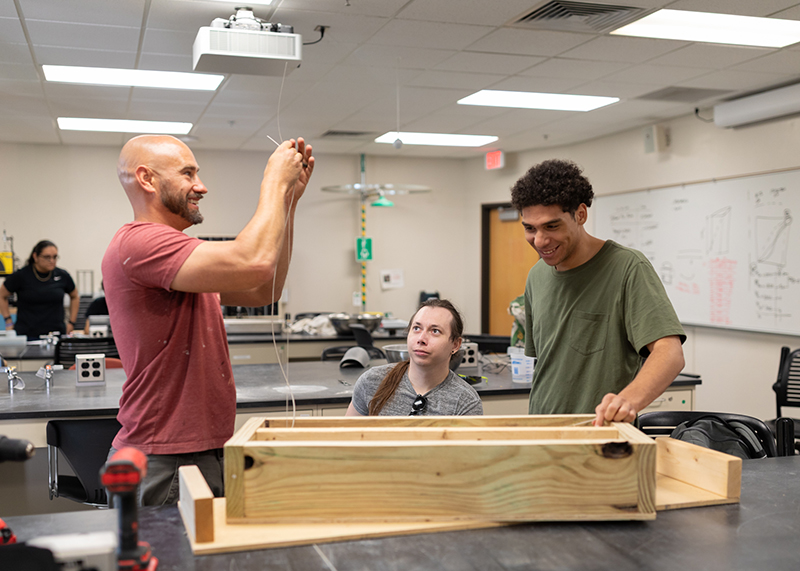
Max Young, Charlie Wolfa, Patrick Niedermair and Caleb Tedesco are working on the prestressed mini-beam project.
Solving problems, building solutions
On a third team, Caleb Tedesco, Patrick Niedermair, Max Young and Charlie Wolfe are working on the prestressed mini-beam project. In place of traditional steel cables, the students use guitar strings to create tension inside of the concrete beam.
Tedesco explained how it works: “The guitar strings are going to be pulled before the mortar mix is poured into the mold. When it dries, the guitar strings have a force inside of them. Then we’ll test the beam to see if they make a difference in its design.”
The testing will determine the beam’s ultimate load capacity.
Students across all three teams agreed that the projects are strengthening their problem-solving skills by compelling them to apply concrete in unconventional fields where it may not be the best material for the project.
“This project does teach you a lot of skills you’re not going to learn in the classroom,” Hart said. “Overall, the process is solving problems and coming up with solutions. That’s what an engineer does, really.”
As they prepare for the ASCE competitions, these students are learning how engineers think, test and innovate in the real world.