Picture this: Elementary school students standing in a cafeteria line, stomachs rumbling for lunch, when they see bags of lettuce they can take to put on top of a burger. You might imagine them walking right by, forgoing the opportunity to add nutritious greens to their meal. But students in the School District of Lee County are grabbing those bags and happily munching on lettuce as a snack. Proudly munching, actually — because they harvested that produce in science class.
For decades, many schools have used on-site gardens to teach students horticulture and the origins of the food they eat. But Lee County garden programs have recently seen new growth through collaboration with Florida Gulf Coast University.
They’ve worked primarily with three schools so far to help teachers set up and maintain hydroponic towers — systems where plants are grown in water instead of soil.
“This is a good system because it saves a lot of space,” Boguslaw says. “You have your plants growing vertically rather than flat on the ground. It’s a very sustainable system when you have a small amount of space to work with, like the interior of an elementary school.”
Making gardening easier for teachers
While some of the schools have been practicing hydroponic gardening since the 1990s, Lee County environmental education resource teacher Susie Hassett says the FGCU students have made maintaining the new tower systems easier for the teachers.
“We got a USDA farm-to-school grant in 2022, and that grant helped us with evaluating our programs, and we were able to have some interns with FGCU going around as in-person support for the teachers,” Hassett says. “When the teachers had somebody showing up to help them do the maintenance checklist — is the irrigation working right, do I have any pests, did we fill our water reservoir — it made it a lot easier for the teachers.”
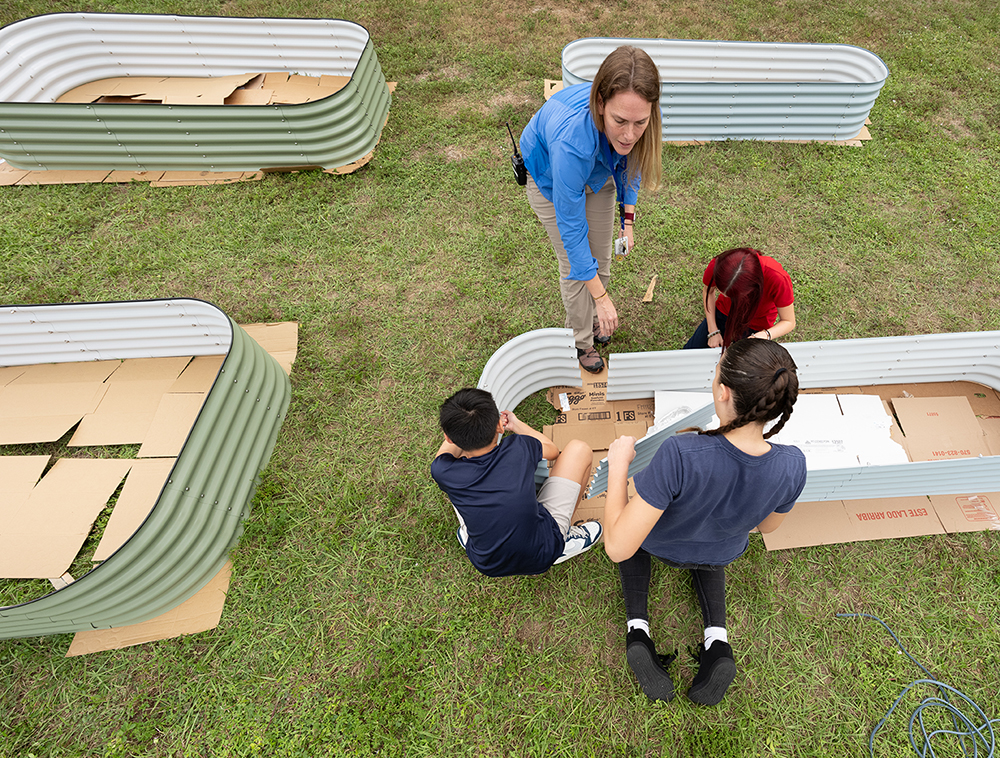
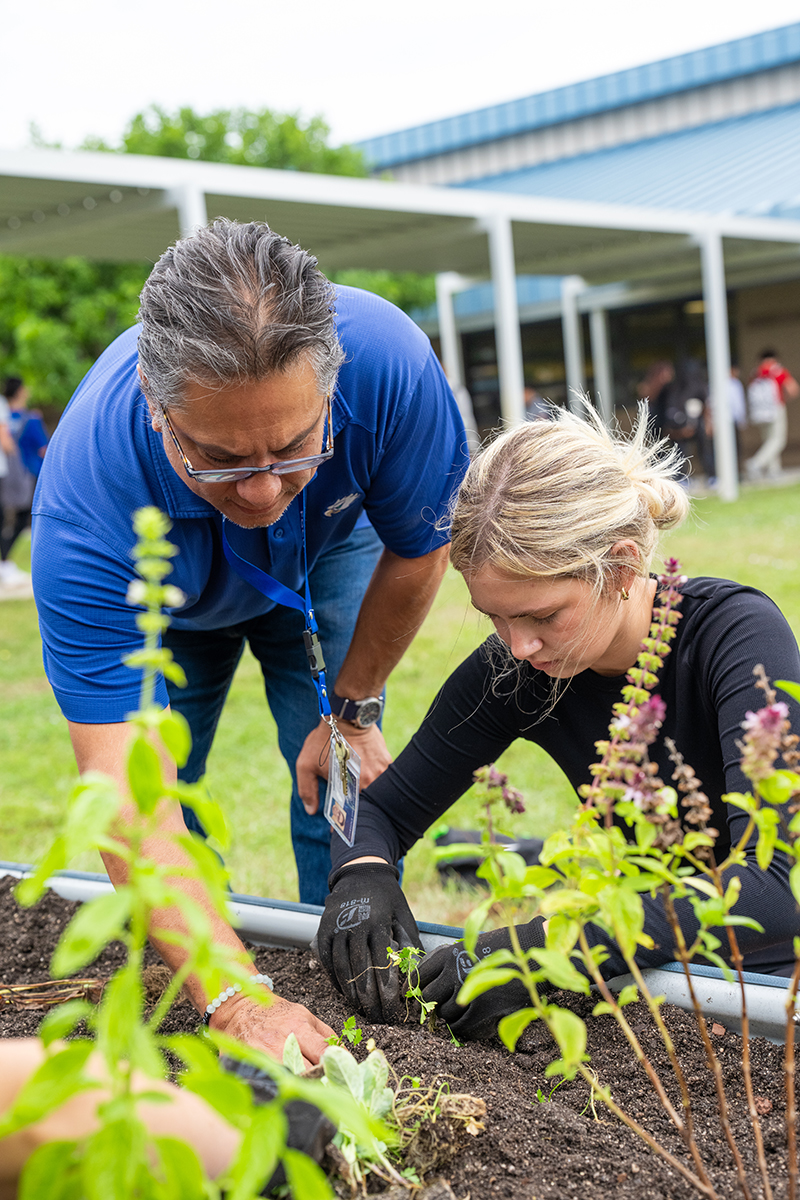
Colleen Jackson, a science teacher at Three Oaks Middle School, helped students set up raised beds for plants.
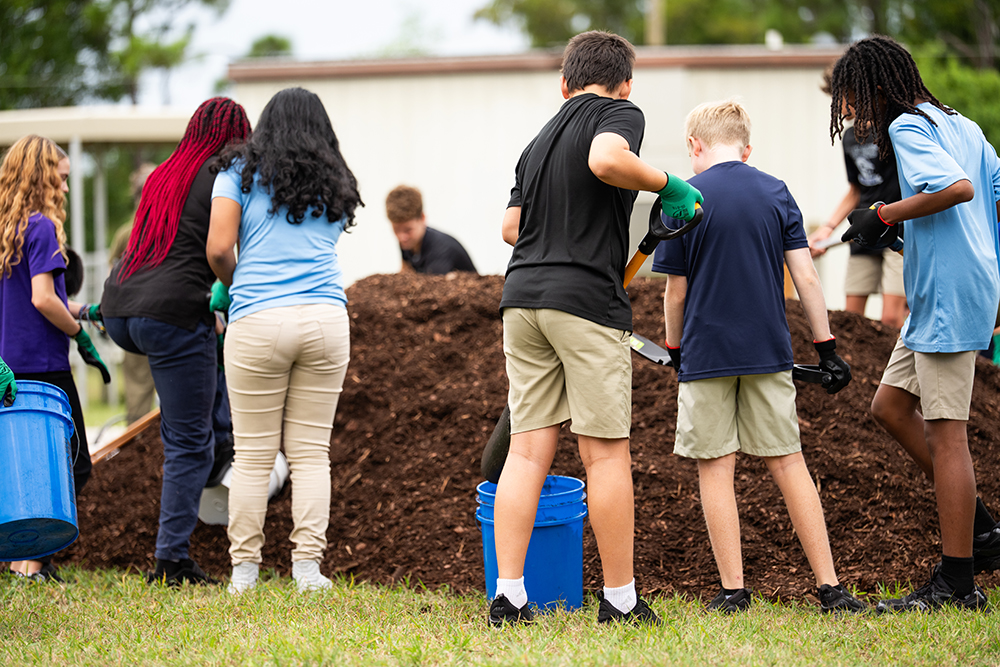
By planting and tending gardens, students learn about horticulture and the origins of the food they eat.
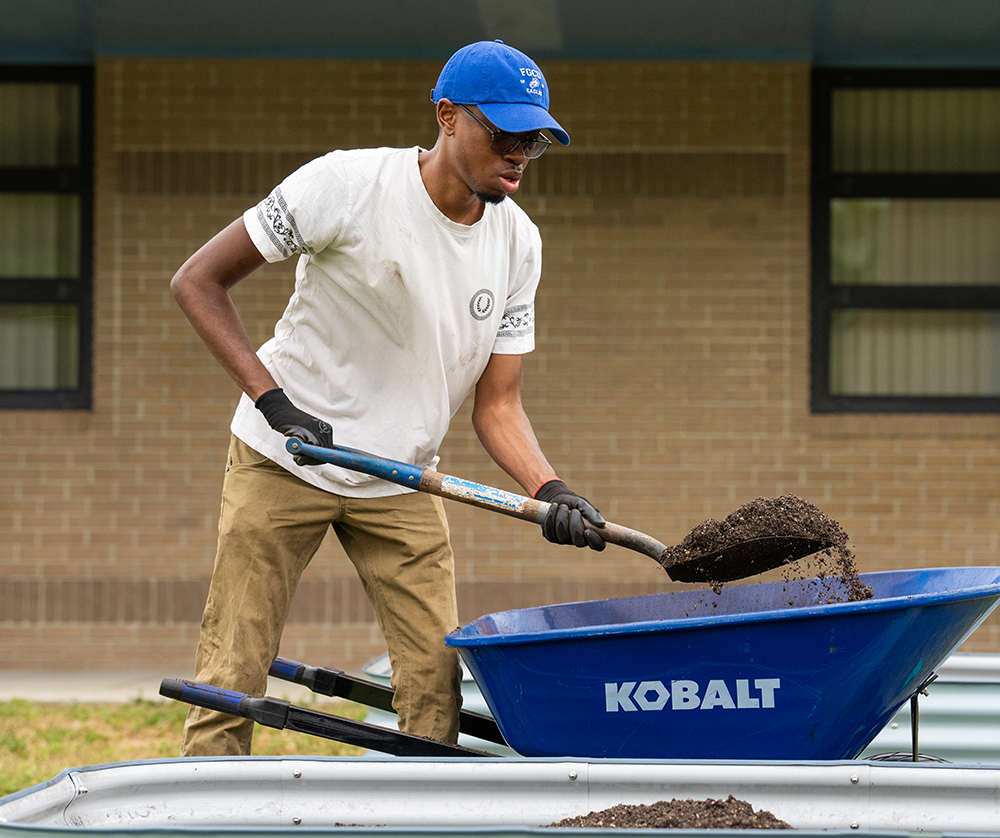
FGCU student Wayne Seide helped fill raised beds with soil.
Recently, FGCU students have built their own hydroponic tower in the Food Forest, the botanical garden near the Sugden Welcome Center. The tower will be used to train more Eagles who can help with the local school gardens.
“Students that have been going out each semester to help set up and maintain the systems are now able to be trained on campus,” Sette says. “We’re able to show them exactly how it’s going to work, train them on the systems more efficiently, and then send them out on volunteer days. We are hoping to make FGCU a sort of home base for outreach for these teachers.”
The Food Forest holds service-learning events weekly, and Boguslaw and Sette plan to offer at least one training a month that is specific to the hydroponic towers.
“Every semester there’s going to be new students to help with this project,” Boguslaw says. “That’s why the training ground is so important.”
Sette has seen firsthand that younger students can be just as enthusiastic about gardening as the Food Forest coordinators are.
“Last semester I went out to Harns Marsh Middle School, and it was a harvest day for them and the kids went crazy,” she says. “They get a real sense of pride when they know that the things they are growing are going to their friends at lunchtime. It’s giving the kids a confidence boost in what they’re capable of, and they’re understanding nutrition from a younger age.”
Hassett estimates that 75 Lee County schools have their own gardens, and 25 are producing enough food to supply to their cafeterias regularly. “There are some schools that are getting quite a lot,” she says. “About four schools can produce enough for their cafeteria. Two schools are producing enough that they can send it to other schools as well.”
Teachers use the gardens to teach topics including nutrition, biology, art, agriculture, environmental studies, literacy and marketing to students of all ages. One high school engineering class even designed a solar-powered system for the hydroponic towers, so schools without an electrical outlet near their gardens can still power a tower system.
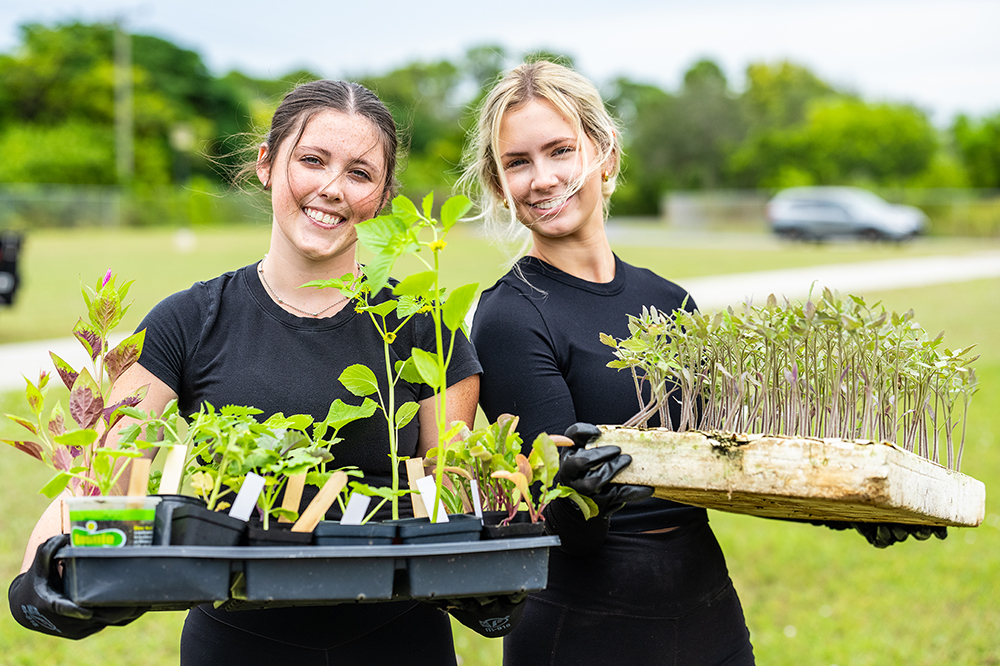
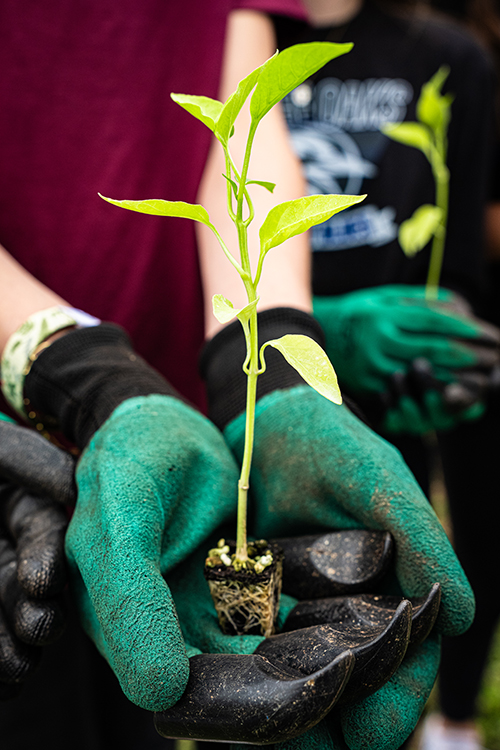
Marco Acosta and Riley Cook transfer potted plants into the beds.
It’s all part of the school district’s Healthy Living Collaboration, an initiative that links school gardens, cafeteria menus, nutrition classes and classroom curriculum to improve overall health and increase food security for families. Many partnerships are making the work possible, including the Sprouts Healthy Community Foundation, the Collaboratory in Fort Myers, and University of Florida’s Institute of Food and Agricultural Sciences. But Hassett says having FGCU students involved is special.
“It’s great to have the students involved because they’re motivating and inspirational for the high school kids,” she says. “The kids look at them as mentors.”
For FGCU students, the experience has been gratifying as well.
“It’s been a really great opportunity to learn how to work with these more technical systems,” Boguslaw says, “but working with the kids has been the most satisfying part.”